Words & photos:
Pierre Baldovini
Pierre Baldovini
From the Swiss border to Lac du Bourget, France
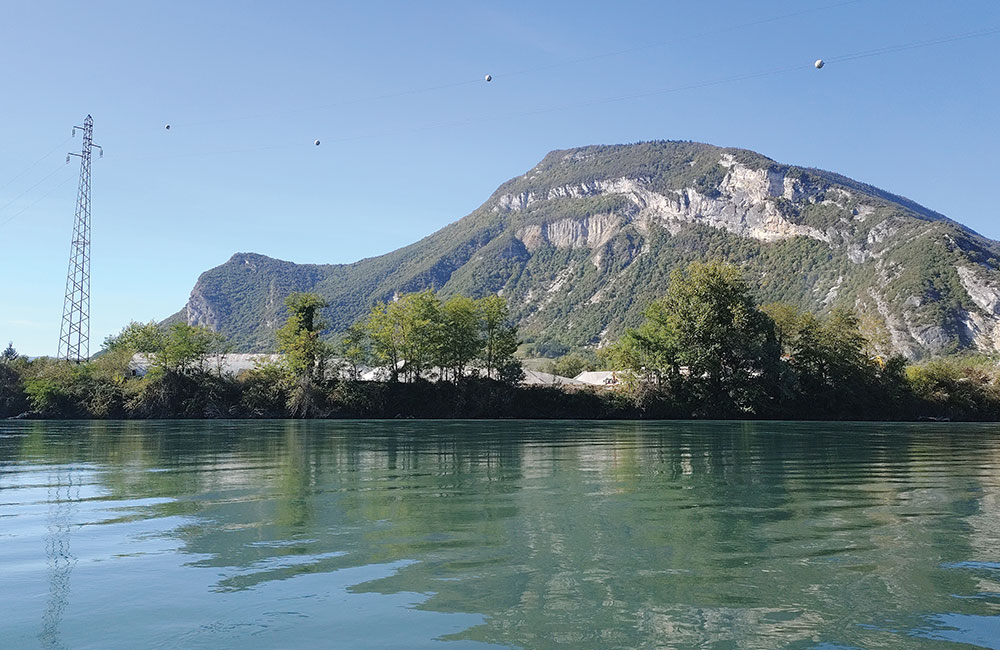
The idea for this trip came from the IGN maps hanging on the wall of my parents’ toilet… They show the Rhône from Seyssel onwards and the Savières Canal, which connects Lac du Bourget to the river. On the map, it looks straightforward, but reality is another matter: the dams mean some strenuous portages, and there are plenty of flat stretches where the kilometres seem to drag on. On top of that, the Rhône is essentially a giant hydroelectric power plant: water levels fluctuate considerably throughout the day depending on how much water is being released through the turbines.
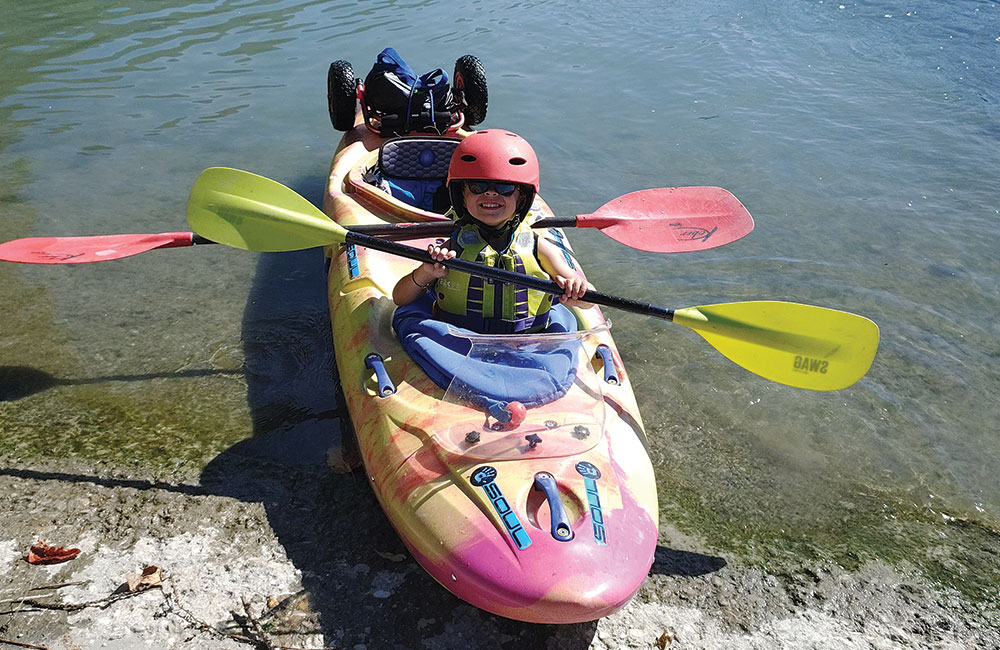
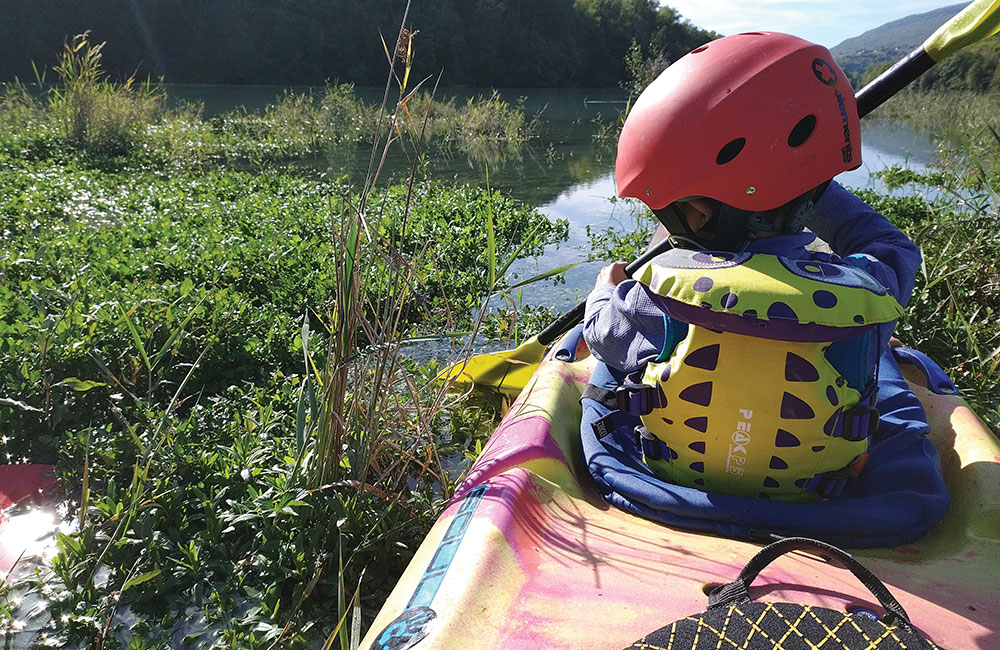
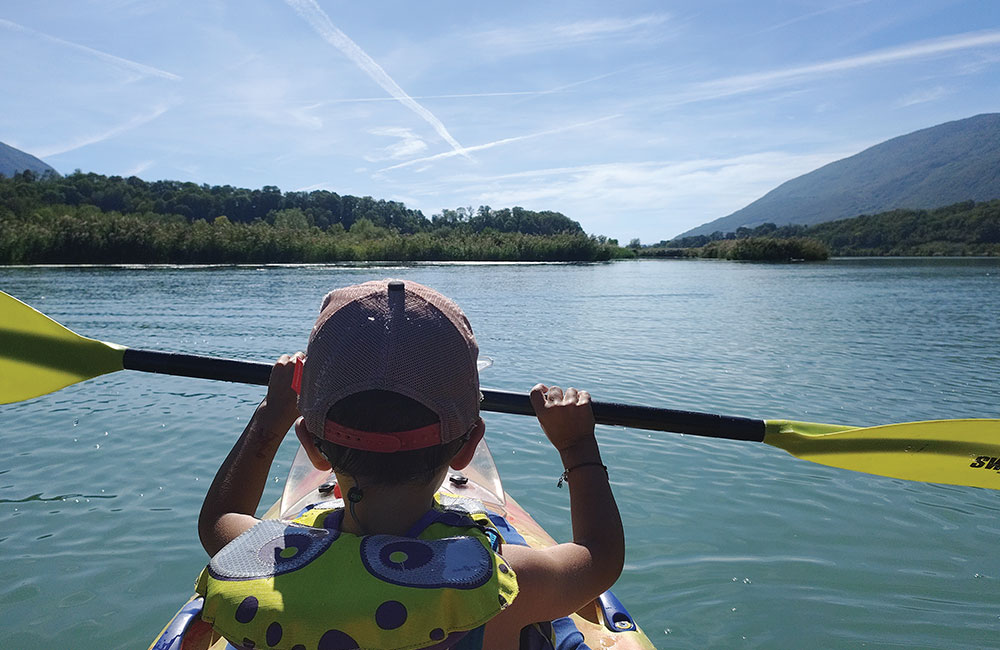
My son Côme has grown up immersed in the world of the Alps and rivers. We have lots of children’s books, including two set around Lac du Bourget, ‘La Dent du Chat’ and ‘Le Monstre du lac du Bourget’, as well as plenty of kayaking magazines for our bedtime reading! So he is immediately excited by the idea of a multi-day kayaking trip.
I discover that a kayaking trip called ‘Rhonolac’ is organised over a September weekend around the full moon. Unfortunately, Côme, who is four, is too young to take part.
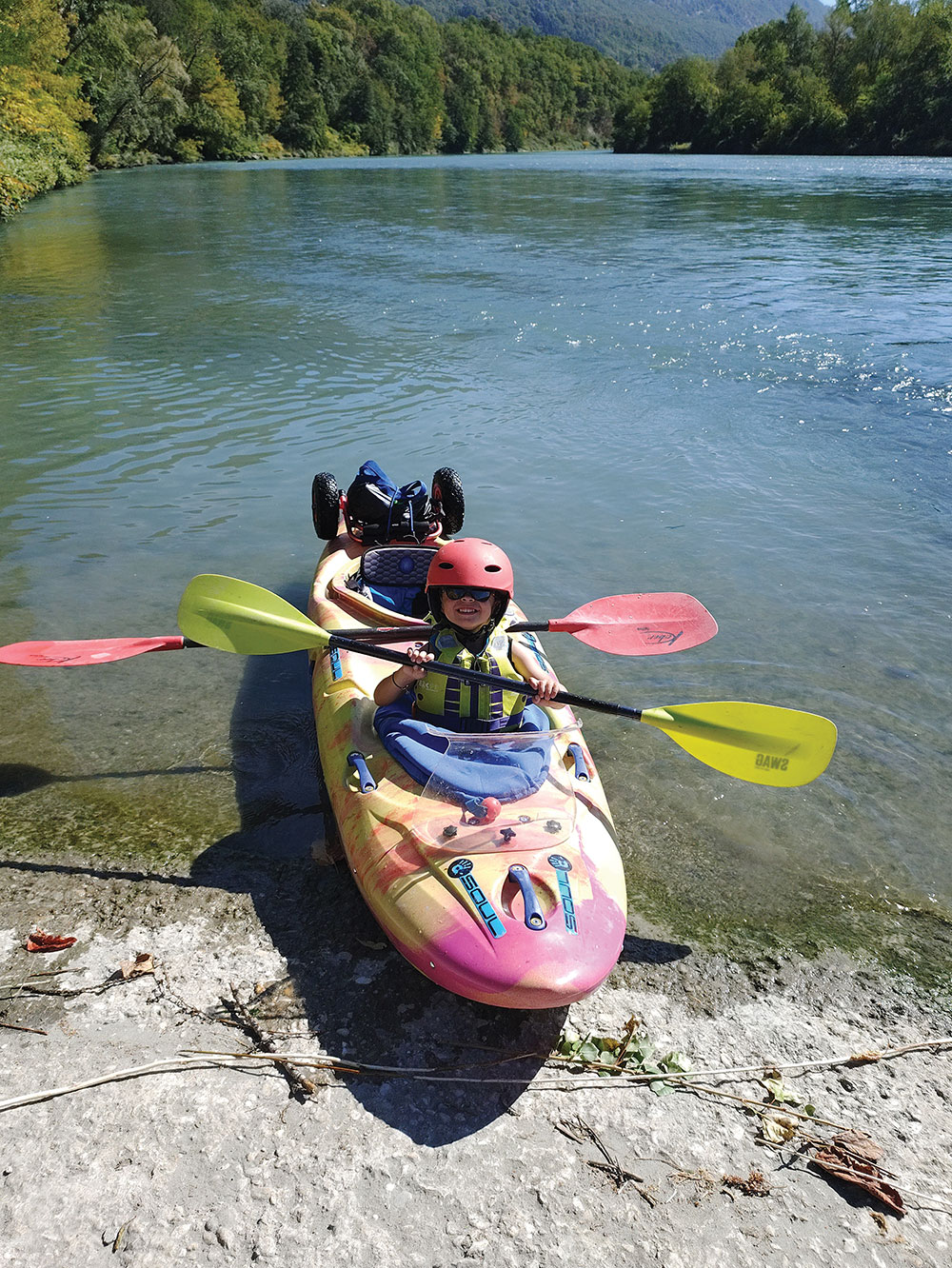
So I decided to organise our own Rhonolac! Côme is no stranger to multi-day adventures. We have already been on several mountain biking bike packing trips (the GTMC, the Tour des Alpilles and the Tour des Madeleines), as well as a short kayaking trip on the Allier between Chapeauroux and Monistrol.
We chose the autumn equinox as our departure date: we will set off from the Swiss border and aim to reach Lac du Bourget by the full moon of the autumn equinox. I let him choose what we will cook at our bivouacs: simple, balanced meals of pasta, mashed potato, sweetcorn, beetroot and cheese for protein.
Day one: Pougny-Chancy bridge
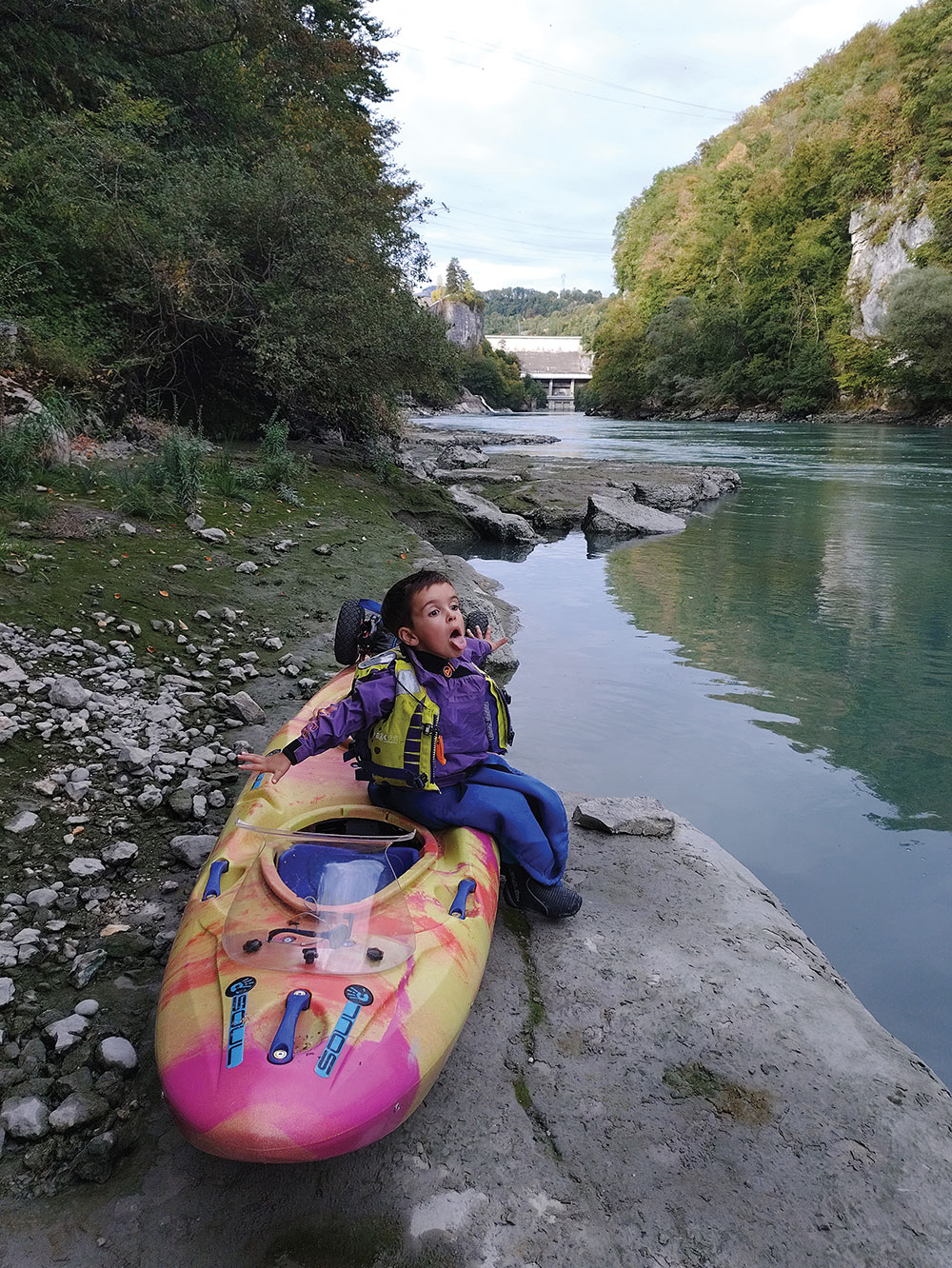
After his morning at school and a three-hour drive, we arrive at the Pougny-Chancy Bridge. We load our gear into the kayak and take the opportunity to scout the first weir, just 100 metres downstream of the bridge. The route through is obvious: a beautiful tongue of water on the left bank, on the Swiss side.
We launch onto this magnificent blue-grey water, laden with silt. We ride over the three waves at the weir, each about 80 cm high, and the kayak briefly takes flight. I congratulate my son and relax, but… too soon. I have failed to spot the boil just behind the waves, and I drop straight into it without enough speed, with the kayak slightly overloaded.
The current catches the left edge of the boat. I correct the tilt, but then the current grabs the right edge while I am off balance. The result: my son’s first capsize, after two years of kayaking together…
He is frightened as we turn upside down. I immediately grab him by his buoyancy aid with one hand, and he calms down very quickly. After about a hundred metres, we manage to catch an eddy on the right bank. It turns out to be an ideal first capsize experience for Côme: the water is warm, and the river is relatively calm.
We empty the kayak on the bank and check our equipment. Everything is still there, except for a stainless-steel water bottle that has unfortunately sunk to the bottom of the river.
After this eventful start, we continue downstream across the plain towards the Étournel Marshes. The place is magical: dozens of swans and herons enjoy the tranquillity.
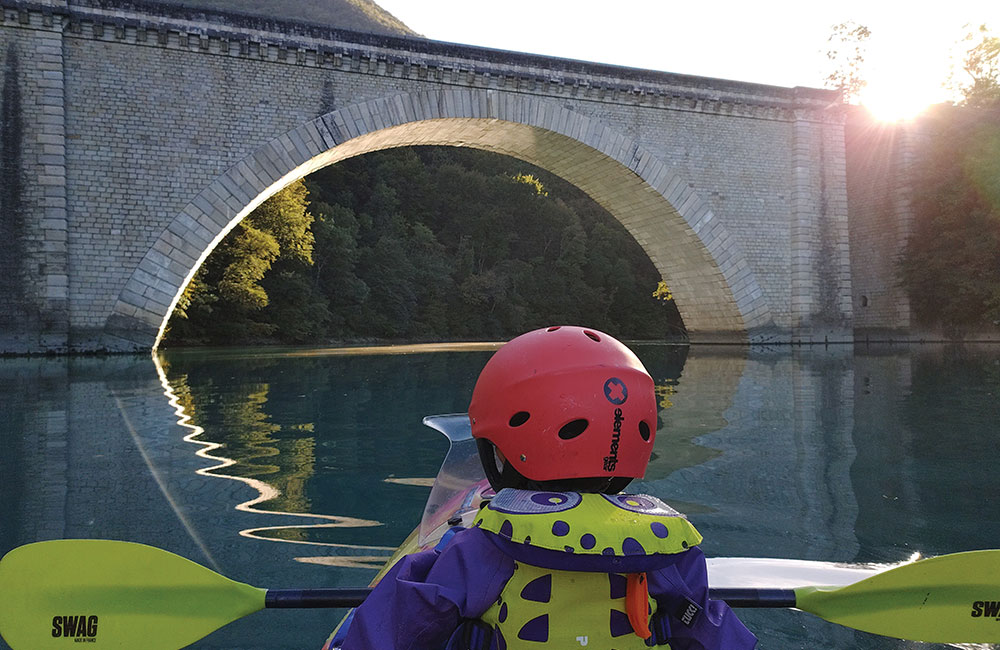
The entire river then funnels into the Écluse Gorge, marked by the Carnot Bridge. We pass Fort l’Écluse on our right and paddle beneath the Longeray Viaduct. The scenery is spectacular.
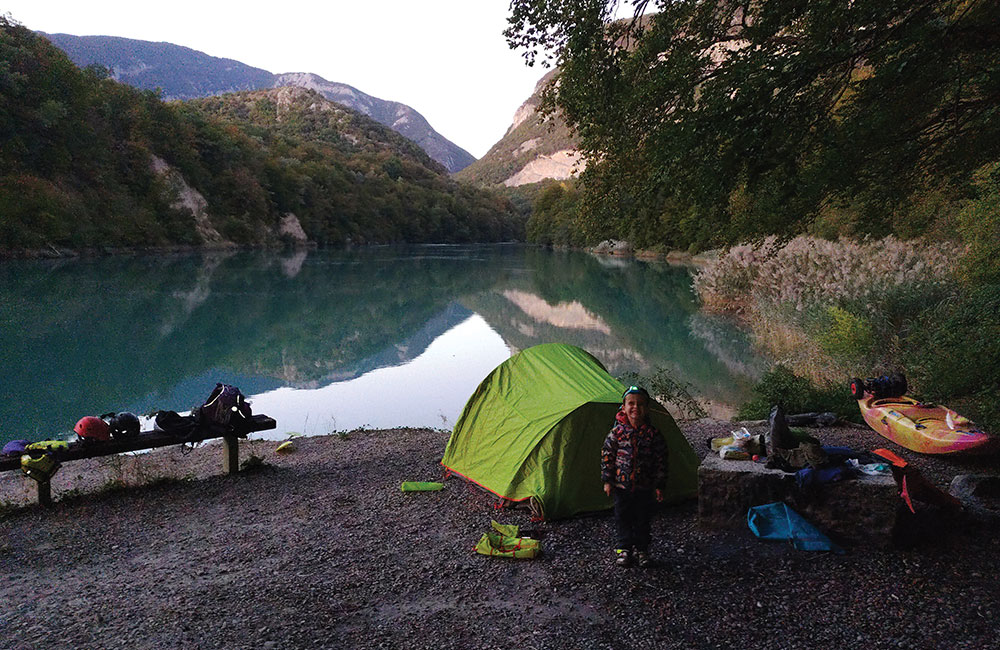
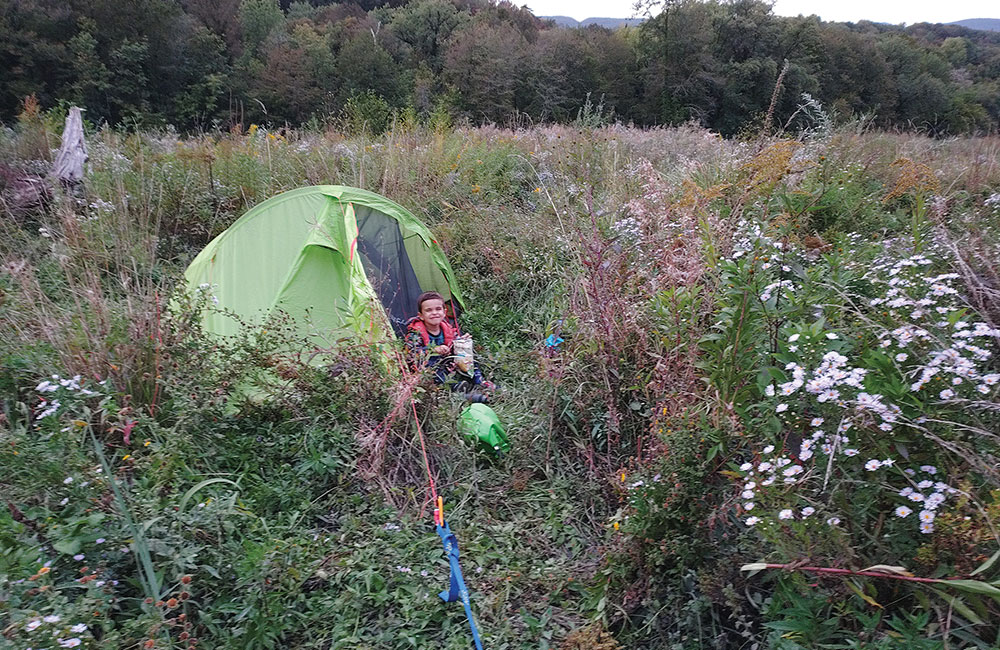
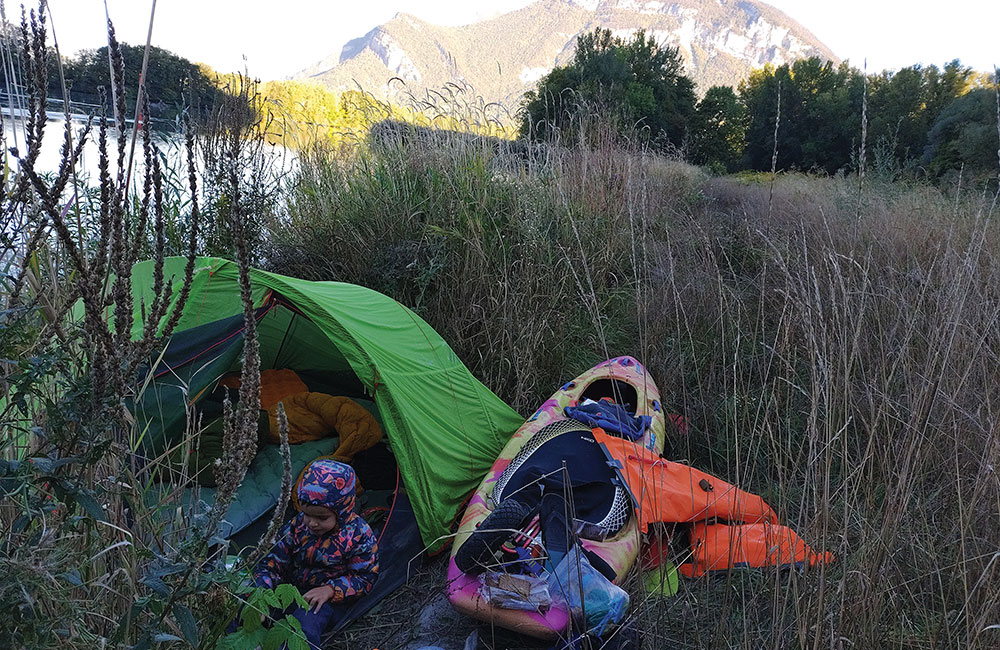
We find a bivouac spot on the left bank, well above the water. The Rhône can rise by as much as 80 cm when the dams release water, so we need to plan – a good meal and a few board games round off the day before a good night’s sleep.
Day two: Tine de Parmant
We launch the second day with our feet sinking into the mud. A hundred metres upstream of the Grésin Bridge, we discover the Tine de Parmant.
The stream and the Rhône have carved deep into the grey-green sandstone. We follow the winding bends until we reach a small waterfall at the bottom of the canyon.
We then land at Valserhône to refill our water supplies and stop for lunch, cooking on our camping stove. We are next to a playground, which Côme is delighted to use.
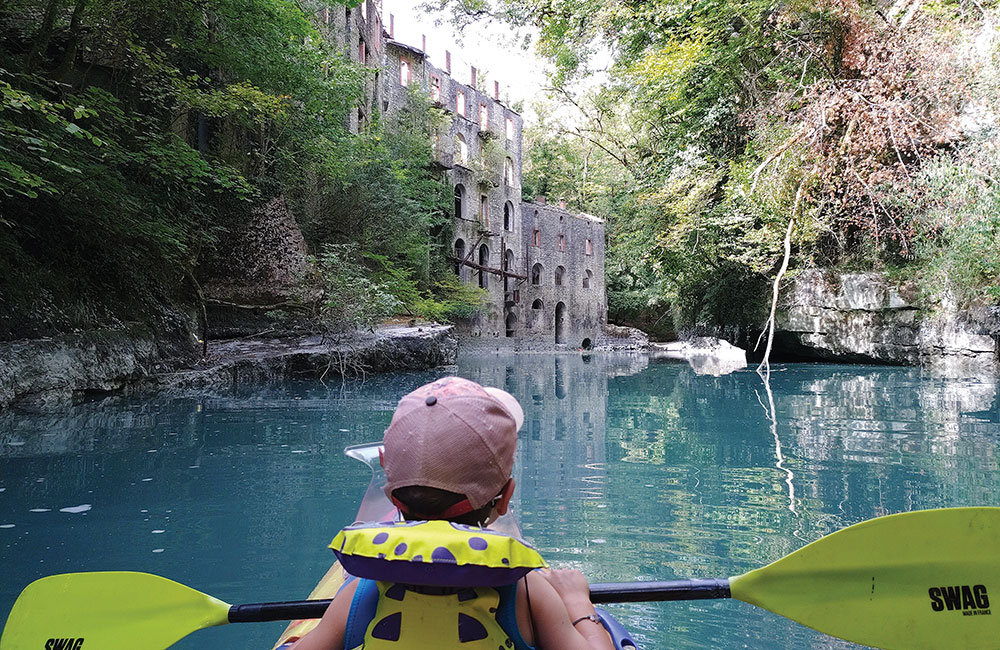
Next, we paddle 100 metres up the Valserine to find the remains of the breached Dumont dam. The view is spectacular, with the imposing ruins on the left bank.
We notice that the Valserine is completely dry because of the drought… A striking contrast with the Rhône, which is flowing strongly.
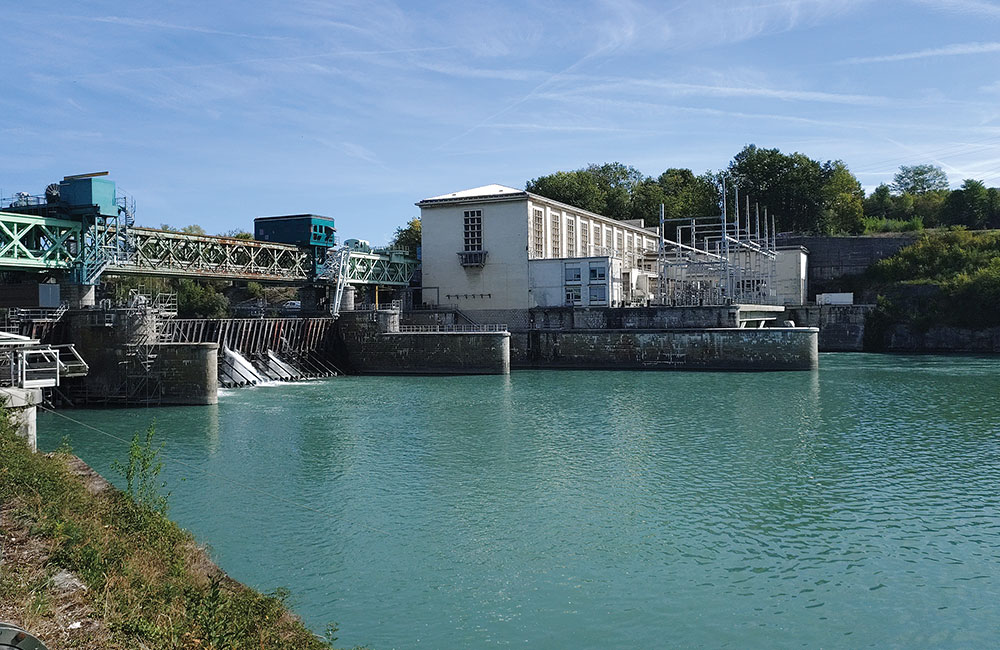
We are now on the Génissiat dam reservoir, where the current is almost nonexistent. Bucolic kilometres drift by one after another. We follow a large workboat all the way to the dam.
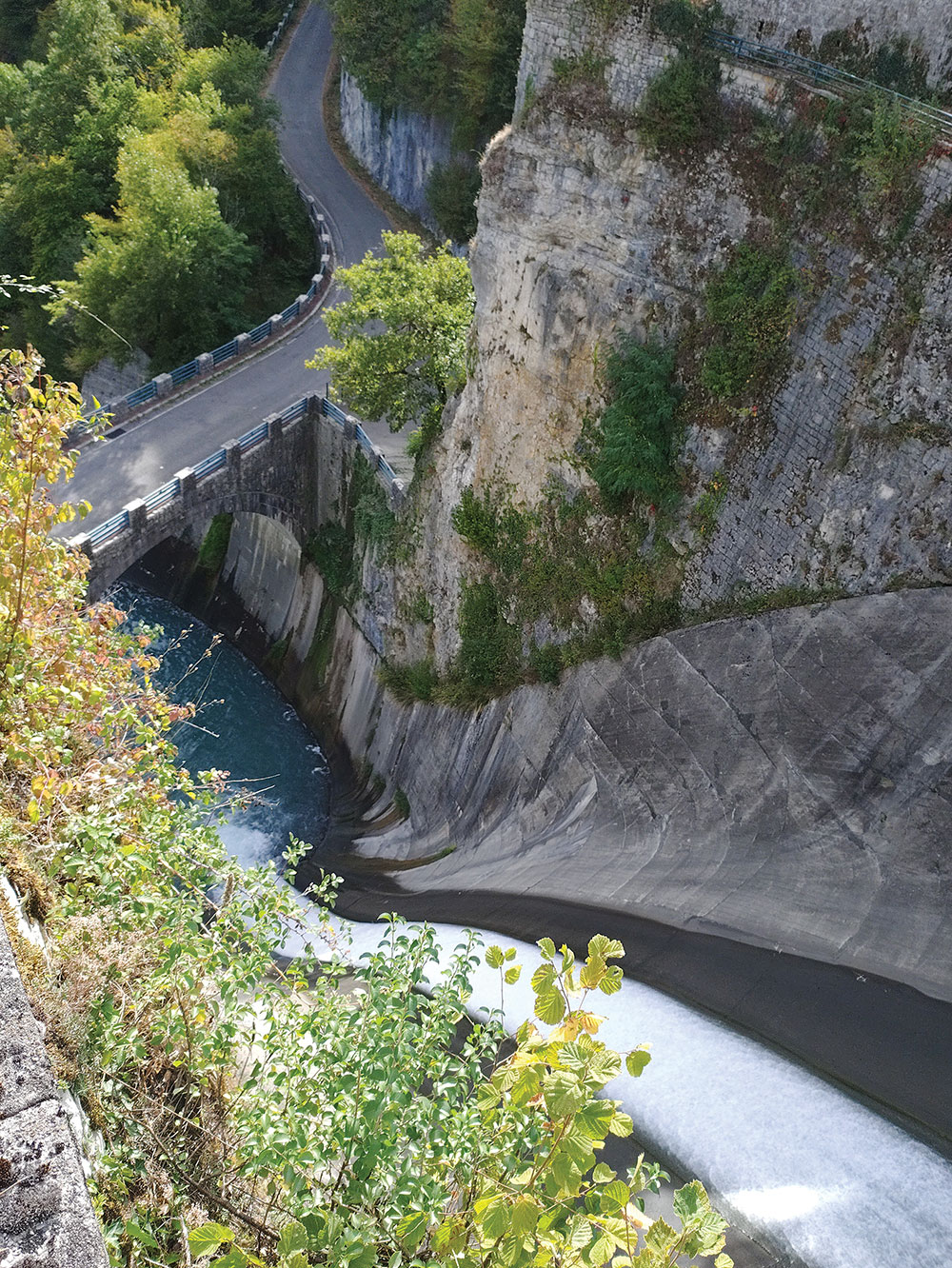
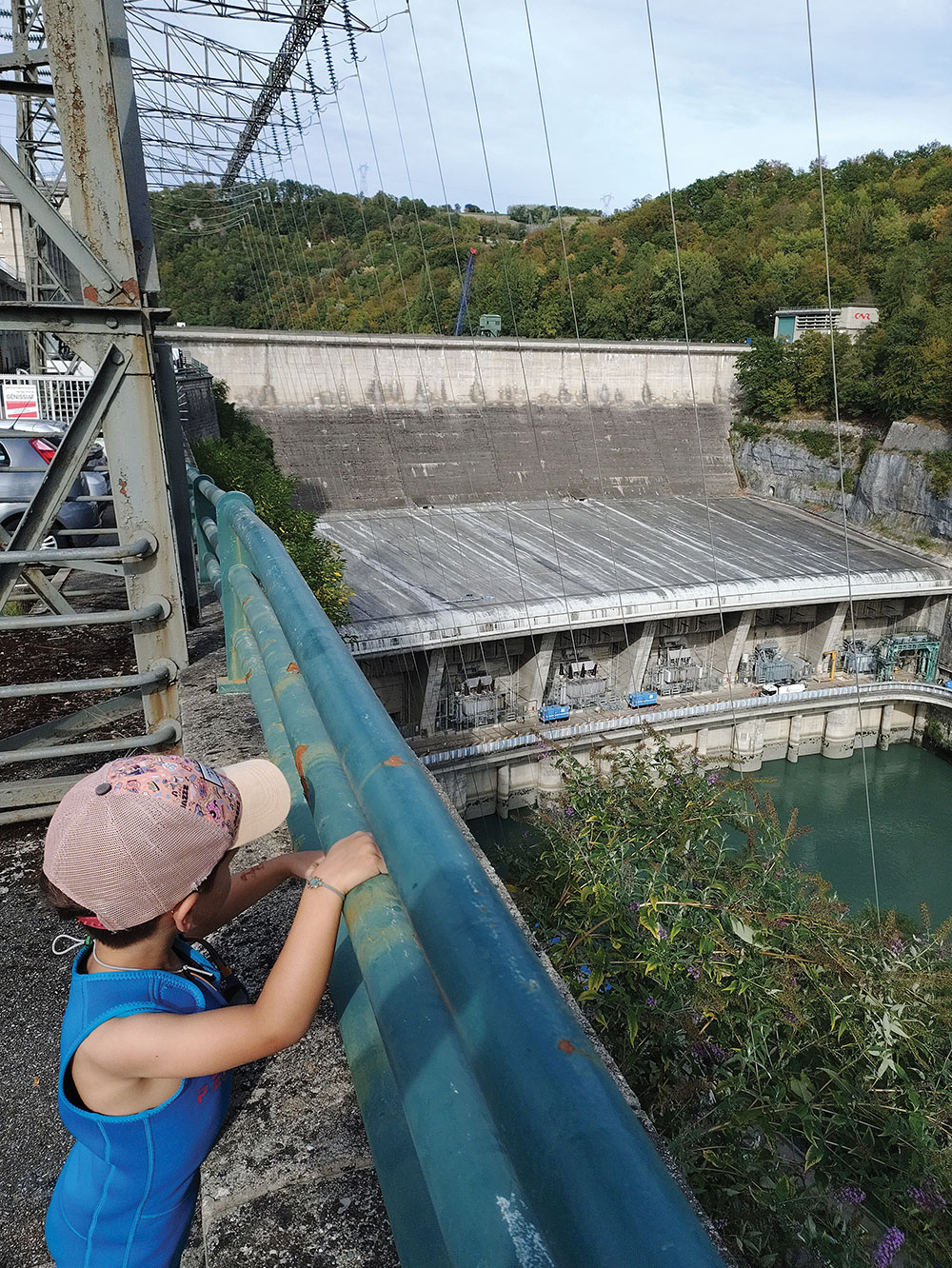
During the portage, we take the opportunity to admire this 100-metre-high giant and its spillway, known as the ‘ski jump’: a spectacular drop! “That would make a great waterslide,” Côme tells me.
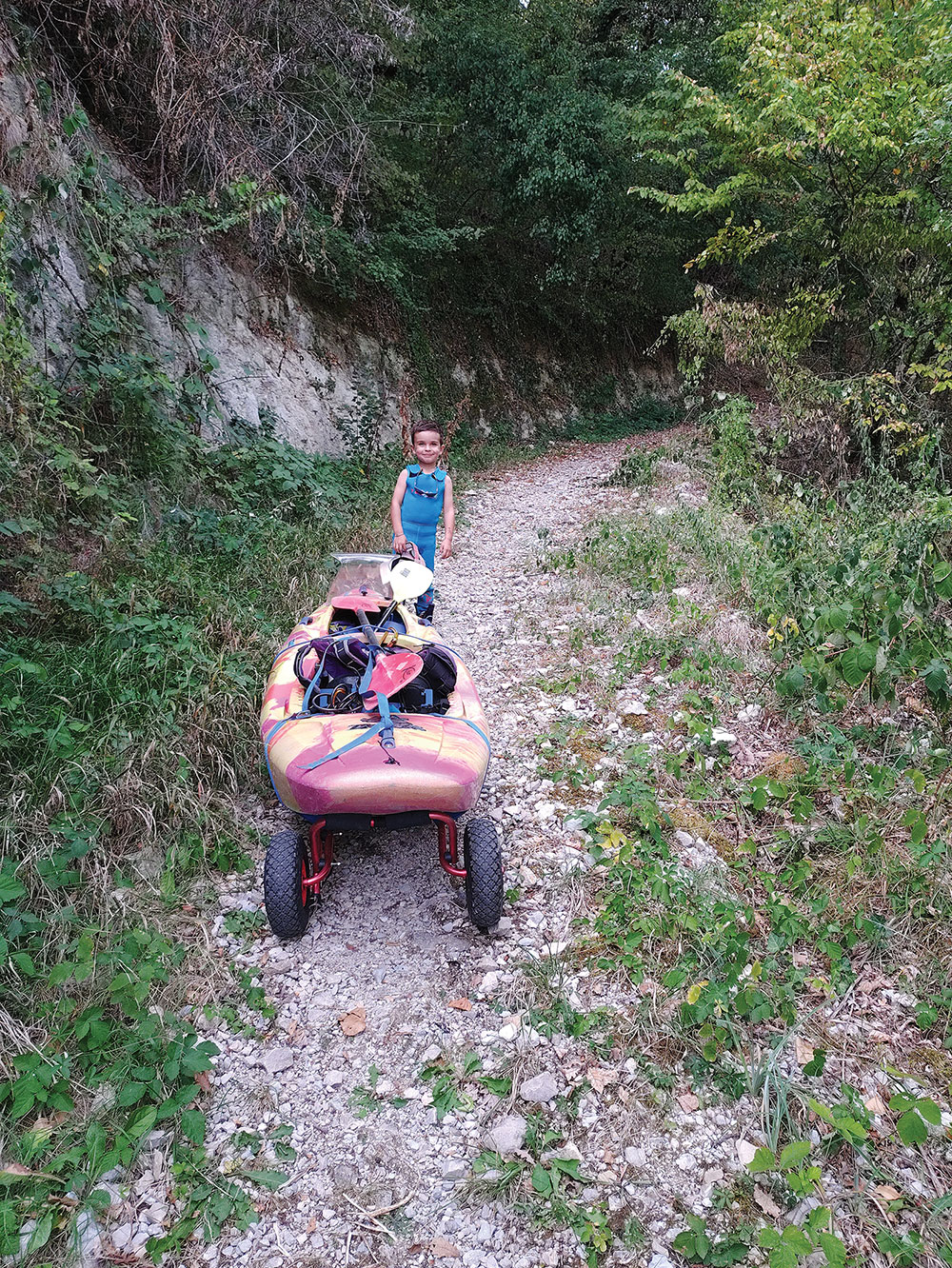
The portage turns out to be long and laborious. At first, we follow a road, then take a steep trail down toward the river.
Côme is exhausted. It is already late afternoon, but he bravely keeps going and follows me. He is happy to rest once he is back in the kayak. We launch again over slippery marl.
The river returns to its natural channel, flowing through a large gorge about 50 metres wide. The current is strong, with small trains of waves and swirling boils forming along the way.
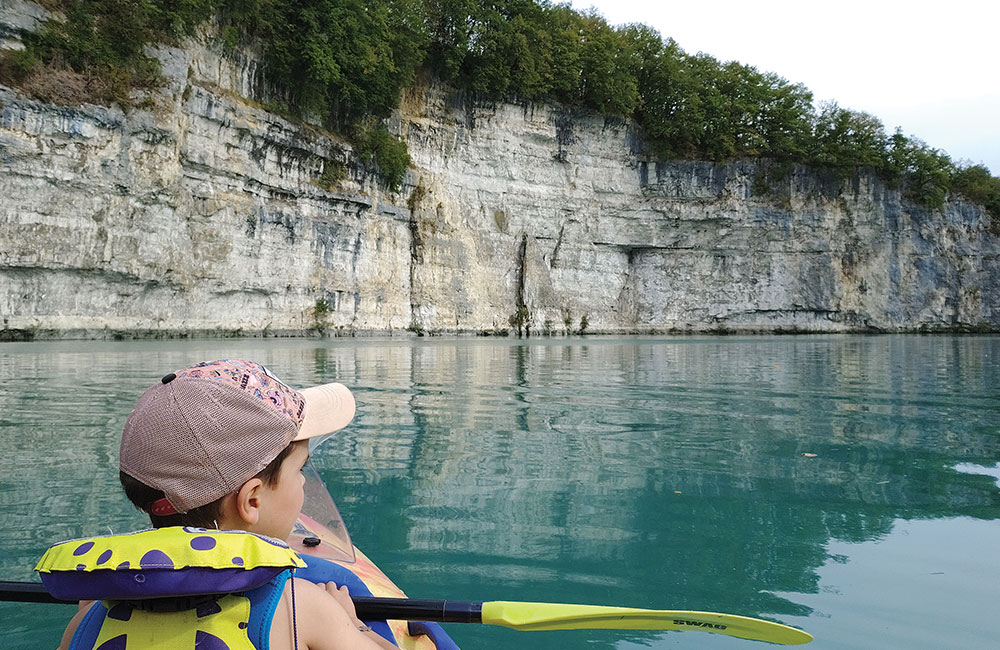
All around us, we discover the old Sainte-Foy Quarries, once worked for their limestone, which was cut on site and transported downstream by river!
As the day goes on, we find an island to bivouac on beyond the old Pyrimont Bridge. We land on a pebble beach and pitch the tent at the highest point of the island to allow for a possible rise in water levels.


Day three: Seyssel Dam Reservoir
Côme wakes at 01:00 with growing pains in his legs. I take the opportunity to listen to the roar of rutting deer in the darkness! I don’t dare wake him in case I disturb his sleep. It is a shame he misses out on this…
By early morning, we can no longer hear the current rushing over the pebbles: the water level has risen considerably, by about 50 cm. We can launch almost right from the foot of the tent!
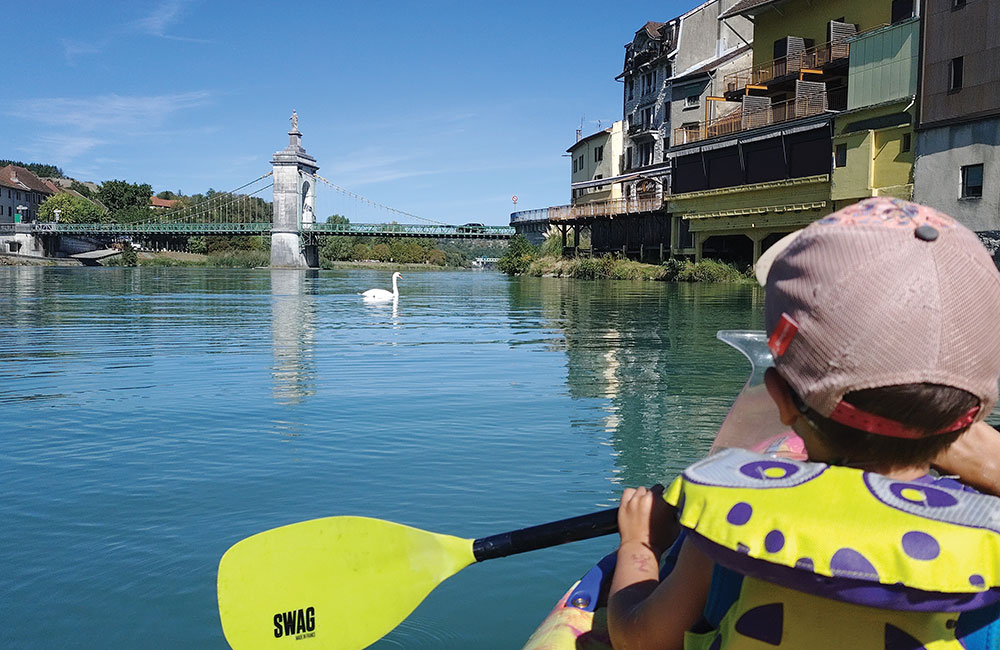
We paddle across the Seyssel Dam Reservoir. We count the swans around us: 42 in total! This dam is less impressive than the previous one, and the portage is easy, following a road along the right bank.
We have now reached the small town of Seyssel. After a meal break, we paddle through the town on a river with no current. We are on another reservoir, created by the Motz Dam.
widened, and the gorges have given way to meadows. We reach the confluence with the Fier. Swans and other birds – cormorants, gulls and ducks – are abundant among the reed beds.
the left bank before launching onto the Vieux Rhône. This is the river’s natural channel, with a regulated residual flow maintained by the dam. The rest of the Rhône remains canalised all the way to the Pont de la Loi.
We make the most of the current and a few rapids to cover some ground while following the Malourdie Islands and the many birds that inhabit them.
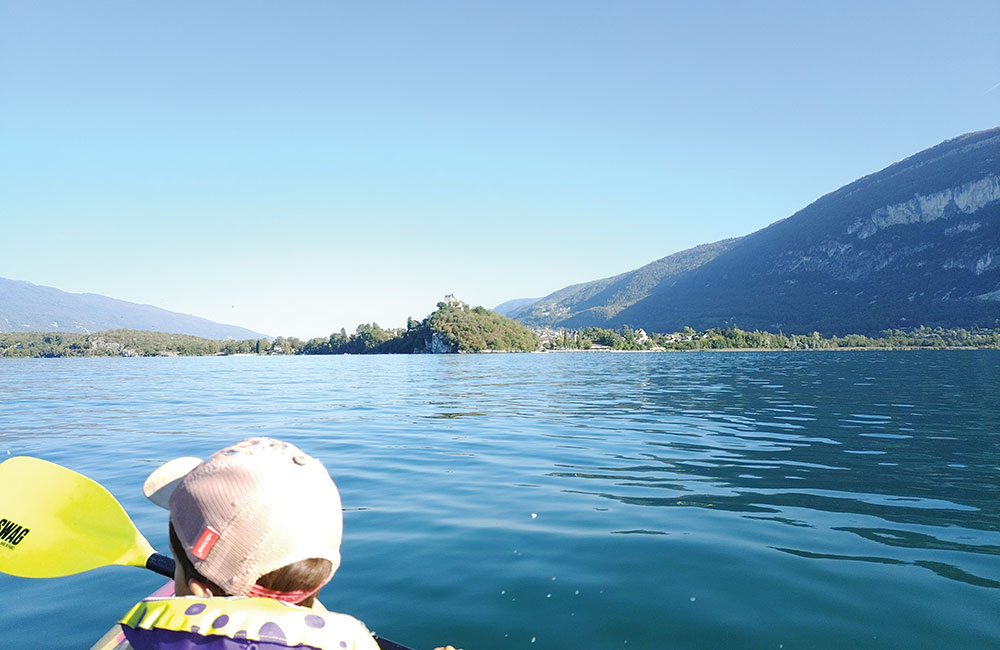
The Dent du Chat is beginning to appear in the distance. Côme is getting excited as we approach Lac du Bourget. We reach the Pont de la Loi, where the river widens even further.
We leave the kayak among the reeds and walk to Vions-Chanaz railway station.
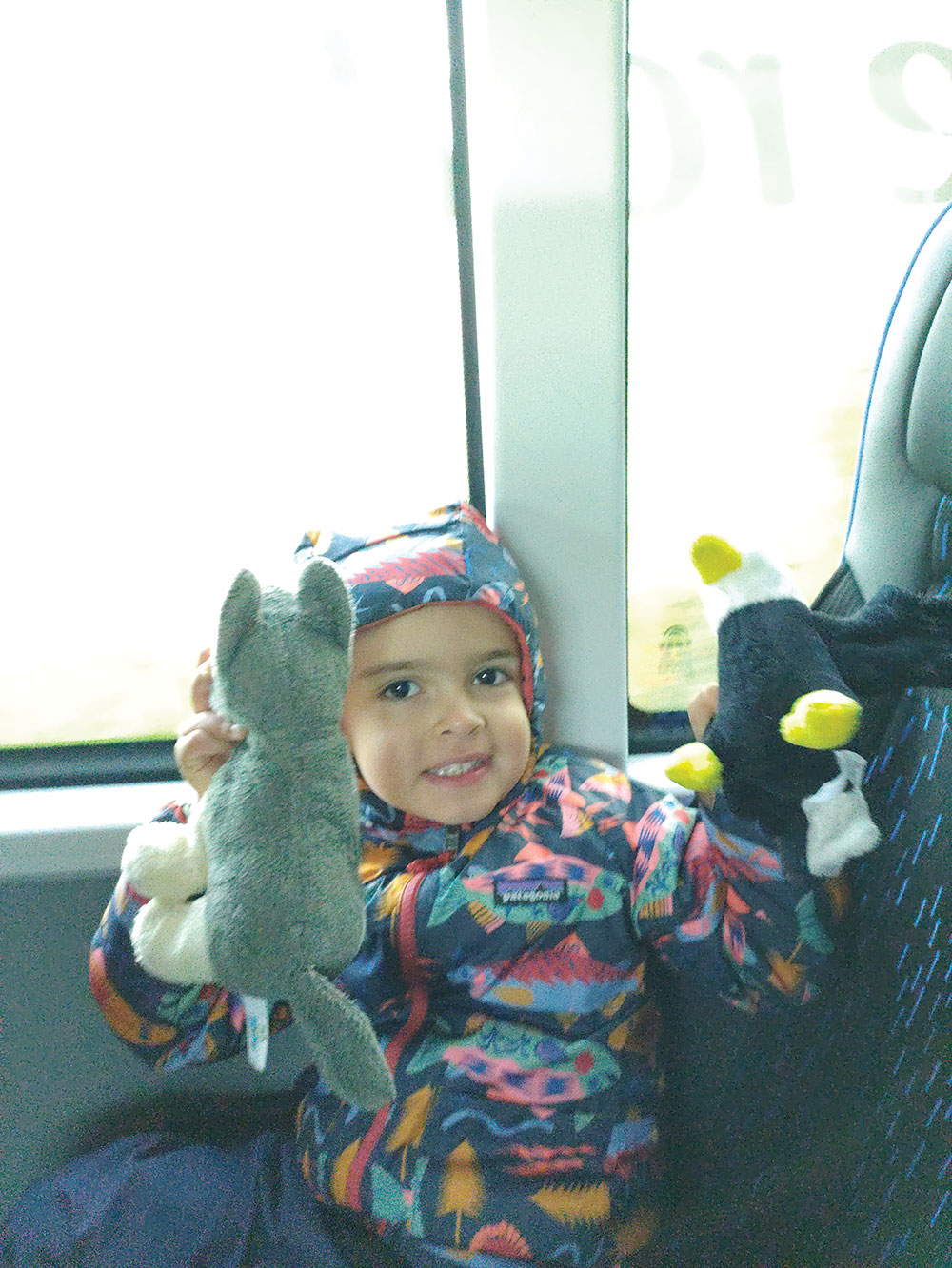
It will take three trains to get back to our starting point, much to Côme’s delight. We even catch the Léman Express, a Swiss train!
After an hour’s drive and a long nap for Côme, we arrive back at the kayak after dark to set up camp. Given how tired we are, dinner will be a quick, cold meal.
Day four: Savières Canal
When we wake up, we drive down to Chindrieux station, near Lac du Bourget, and catch a bus back to Vions.
We launch onto the Rhône once more, on another reservoir formed by the Lavours Dam. We follow the left bank, still surrounded by swans, until we reach the Savières Canal embankment.
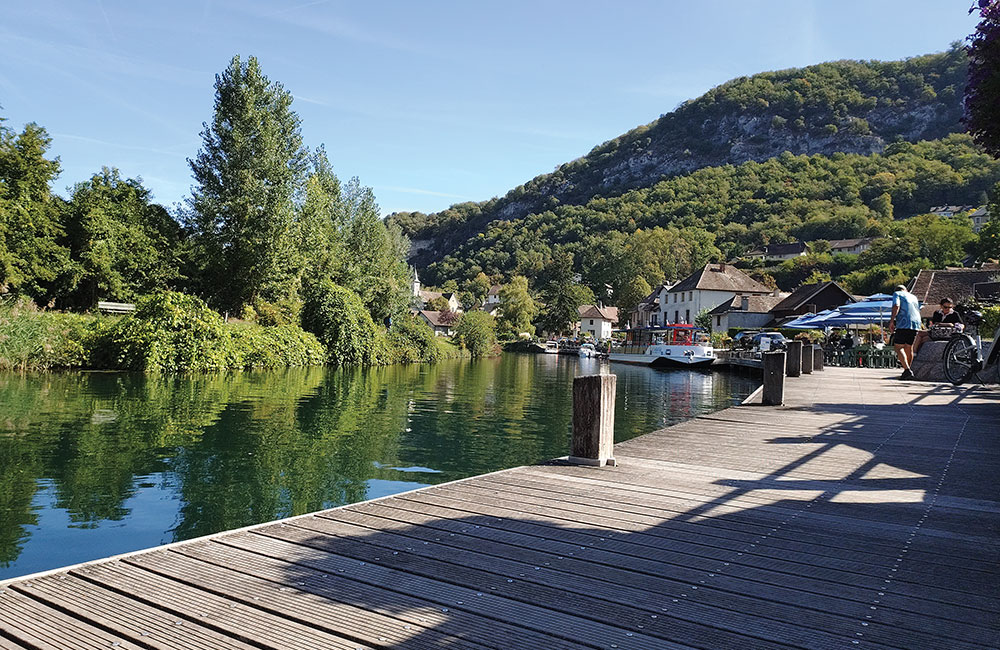
After a short portage, we launch directly onto the Savières Canal, the gateway to Lac du Bourget. We paddle peacefully among motorboats and stand-up paddleboards until we reach the town of Chanaz, which we explore. It is a beautiful little town, with its pontoons and historic buildings.
Four and a half kilometres further on, after paddling through idyllic scenery – apart from the road that sometimes runs a little too close on our right – and encountering a viper swimming alongside us, we reach the reed beds marking the entrance to Lac du Bourget.
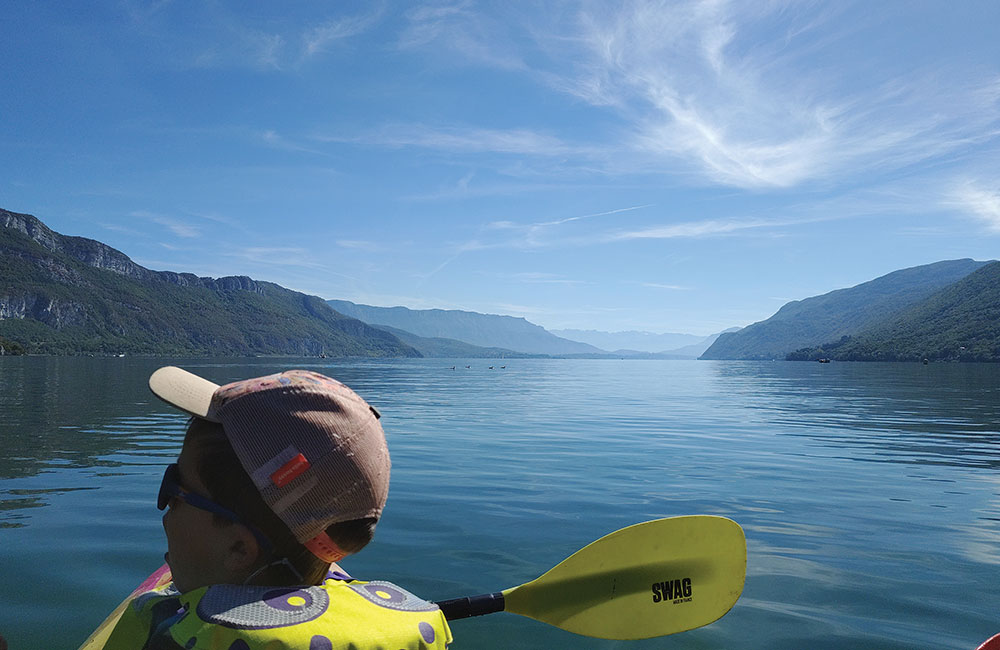
After four days spent following the river and its dams, the atmosphere changes completely. Our arrival is spectacular: an extraordinary panorama opens up before us, with jade-green water surrounded by mountains and the Chartreuse massif in the distance. Côme is delighted: we have reached our goal.
We cross the lake, surfing the small waves created by the wind and passing boats. Côme insists on getting as close as possible to the motorboats so that we can catch as many waves as possible!
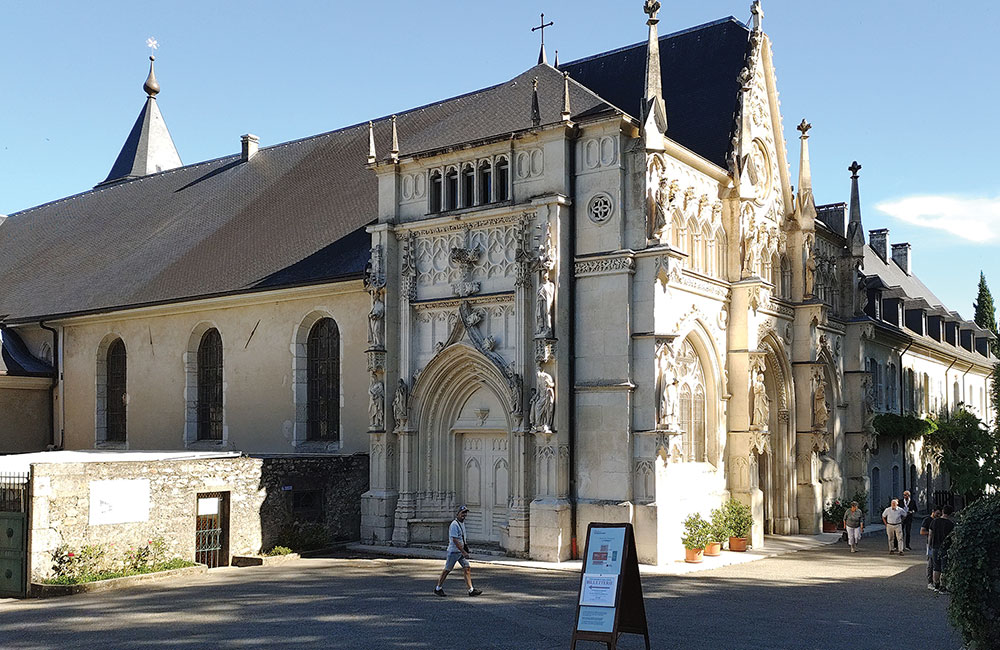
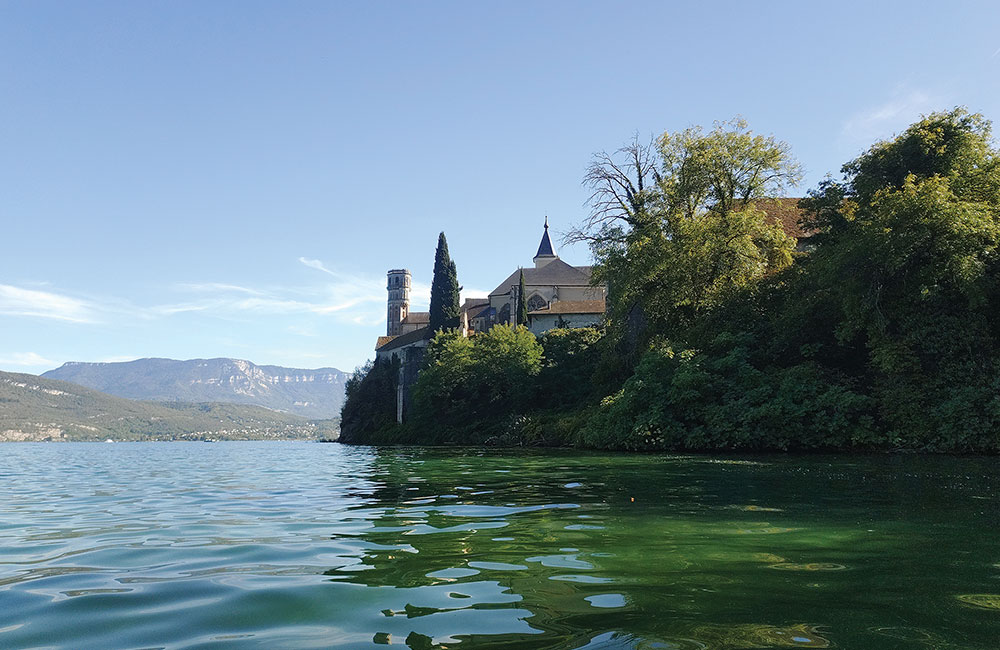
We paddle towards Hautecombe Abbey, which overlooks the western shore of the lake. We land at the old boathouse to visit this historic site.
We meet up with the participants of the Rhonolac – the real one! The buildings are magnificent.
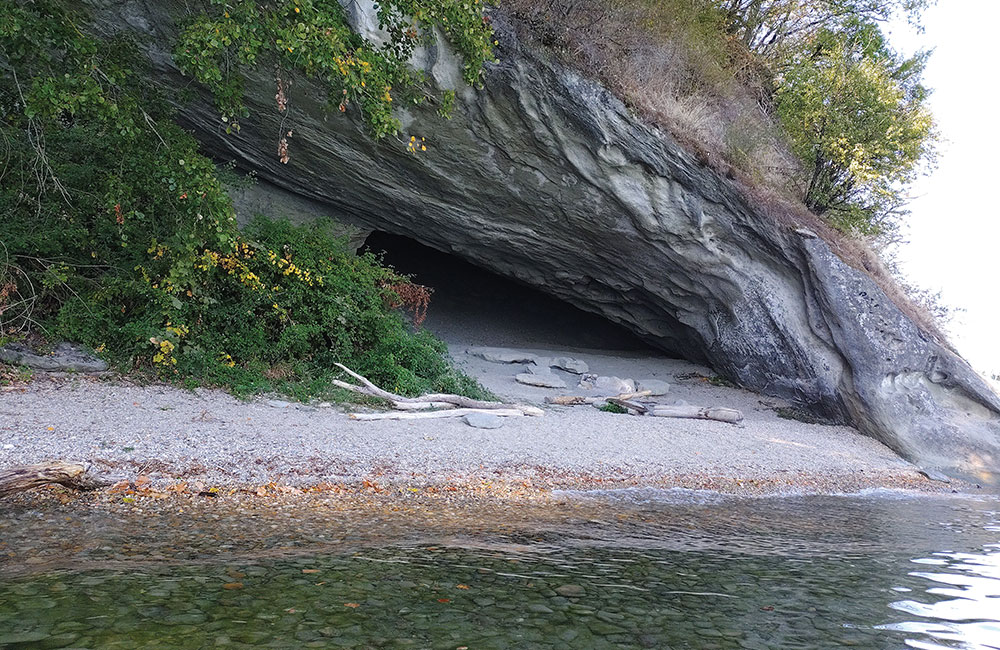
We find a bivouac spot on a wild stretch of shore.
rest of the afternoon, we collect pebbles and make sandcastles in the grey sandstone sand, enjoying our last full day in this idyllic setting.
I ask Côme if he is happy to be going home. “Yes, but I would have liked one more night in the tent.”
The sun sets behind the Épine massif, making way for the full moon of the autumn equinox, which illuminates the lake. We spend a while gazing at the water and the lights of Aix-les-Bains.
There is nothing left to do but enjoy this last evening outdoors. We decide not to put up the tent’s outer flysheet so that we can make the most of the view. We fall asleep to the gentle lapping of the waves.

Day five: Châtillon Harbour
The sun begins to rise, lighting up the windows of Hautecombe Abbey. Then its warmth reaches us, allowing us to dry our last few wet items. We pack all our gear and take the opportunity to clean up the site, collecting the plastic rubbish left behind.
We cross the lake one last time to reach Châtillon Harbour, where our vehicle is waiting for us, 500 metres uphill, near the station. We savour our final moments on the water, surfing the small swell rippling across the lake. The scenery invites us to stop and take it all in.
Côme asks me, “Will we go all the way to the sea one day?” I reply, “Maybe next time, either down the Rhône or along another river.” There is no shortage of ideas for future adventures. For now, I let him grow at his own pace, respecting his learning journey in whitewater and adventure.
That is the main purpose of these trips: to introduce him to, and help him appreciate, the simple pleasures of spending time in nature, whether on land or on the river.
We leave the lake and head home, our minds filled with images and memories.