WORDS:
UNAI ALDANA
PHOTOS:
UNAI ALDANA &
PEP JUANEDA
Meet the author
Unai Aldana
Bio
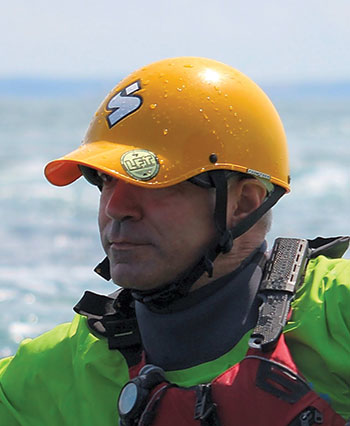
Basque-born, 20 years on Mallorca, where he first discovered kayaking. He paddles La Roqueta year-round with its small but growing community, has gained his Advanced Sea Kayak Leader award, spent a season guiding in Lofoten, and is always dreaming up the next trip. Visiting paddlers are always welcome – with thanks to the friends who share the water here.
@unai.seakayak
Facebook: Unai Aldana
Rock gardening in Mallorca
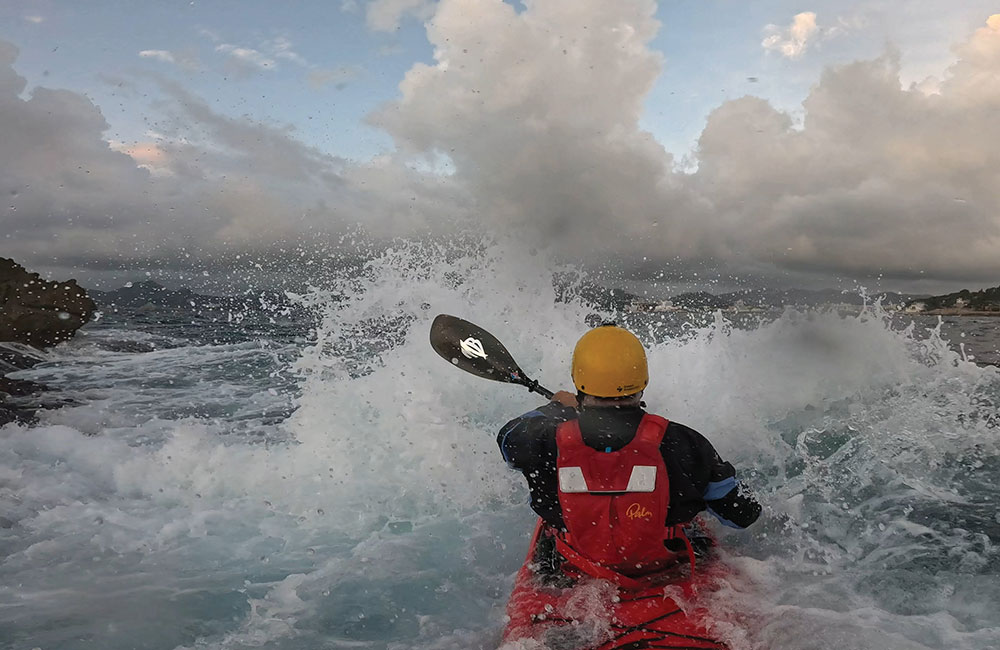
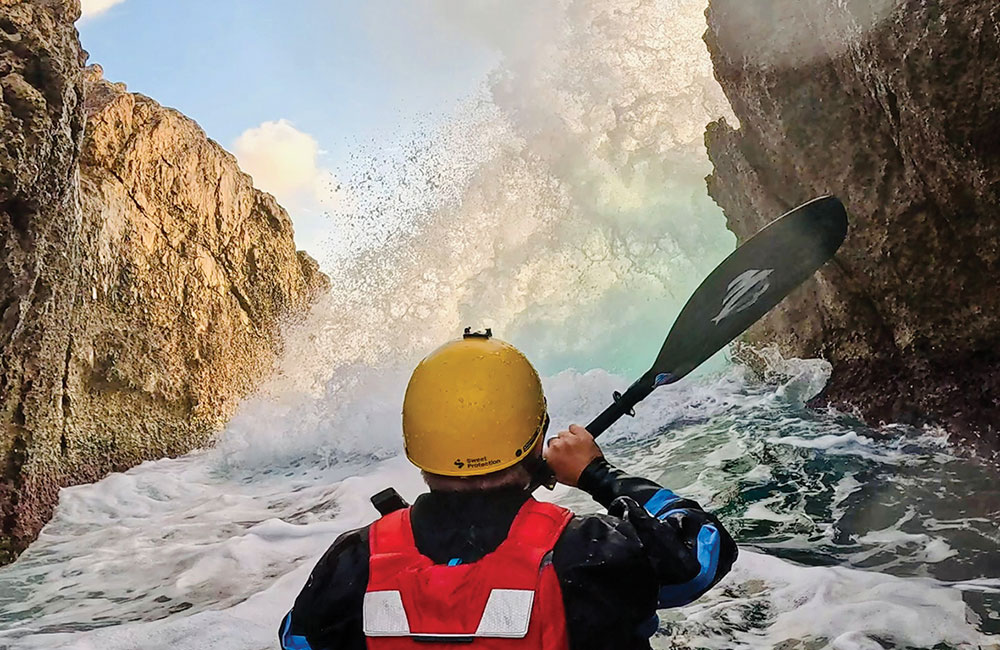
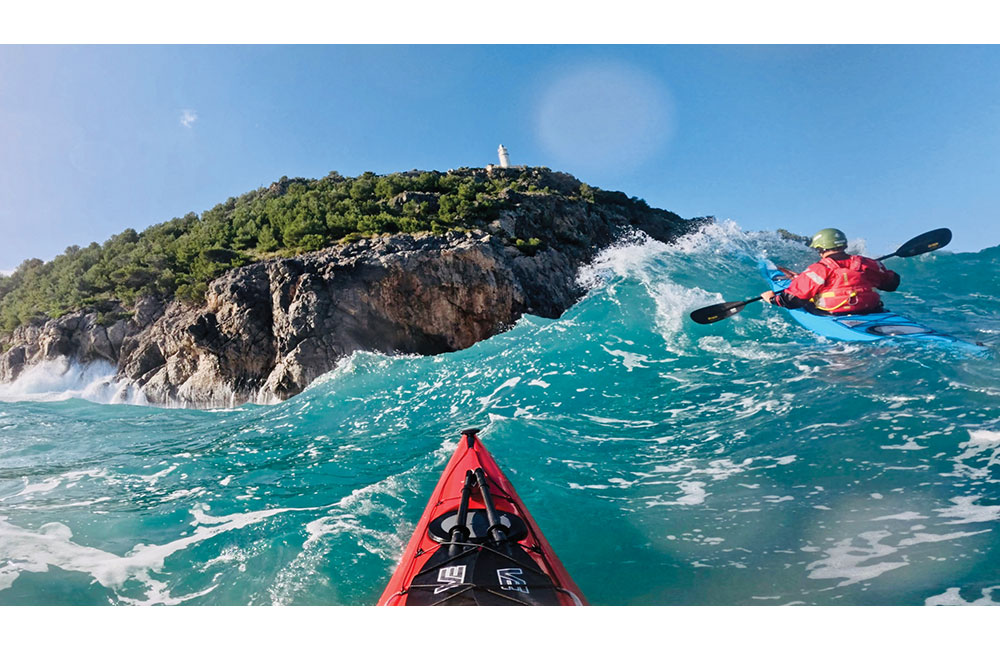
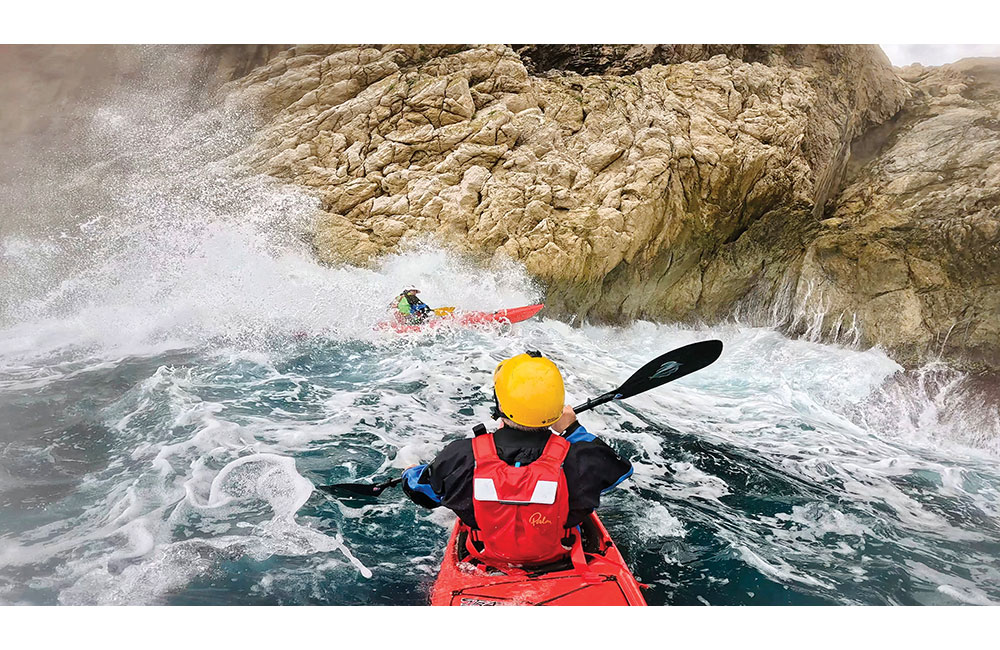
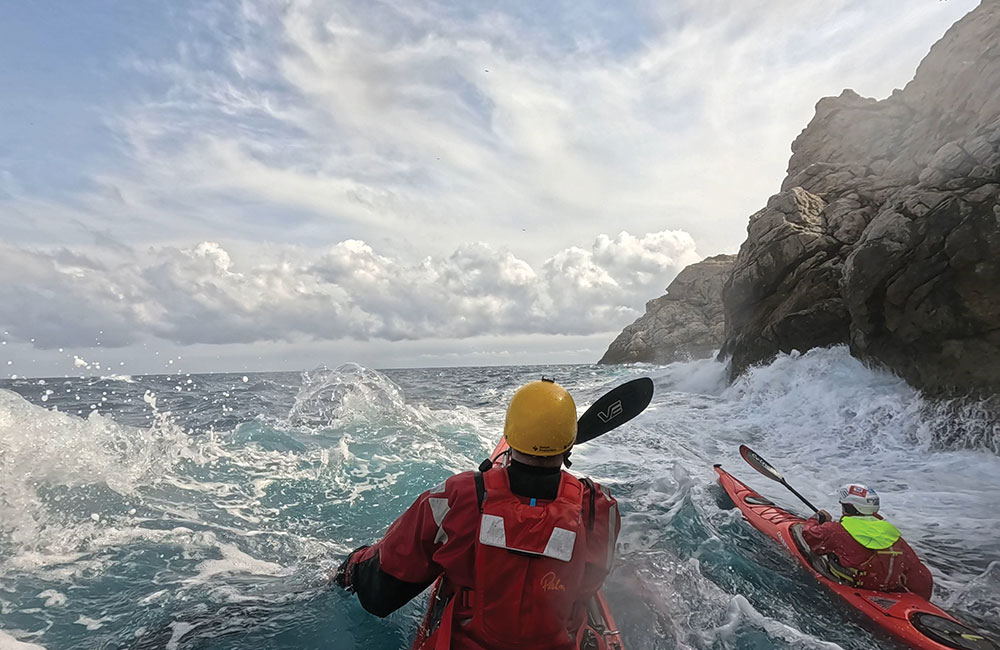
There is a moment, right before you commit to a gap in the rocks, when everything goes quiet. The swell lifts behind you, the walls close in, and the only job is to read the water and trust your blade. This is rock gardening, and La Roqueta – ‘the little rock,’ as we call our island – was quietly built for it.
What rock gardening actually is
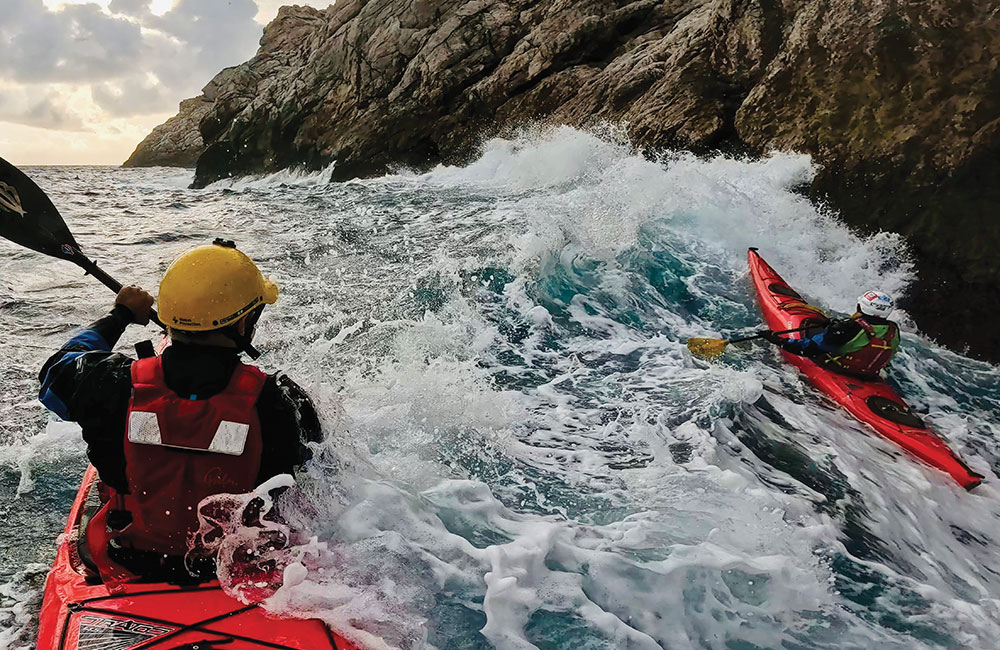
Rock gardening – rock-hopping, if you learned the word in Britain – is the art of connecting your kayak to the ocean as it surges through and over coastal rock: threading gullies, slipping through slots and arches. Bill Vonnegut of Neptune’s Rangers separates it from mere ‘rock bashing’ not by danger but by intent: bashing is smashing a boat into stone; gardening is reading the water so well that the kayak flows through it. Eric Soares, who helped invent the discipline, called it a ‘school of hard rocks’: you will bash and crash, and the point is to do it less.
Paddlers travel the world for it; quietly, you do not always have to.
The crews who wrote the language
Eight years in – and what fills them is what counts: hours of practice, and a comfort zone pushed outward deliberately and safely. The discipline has a lineage. In the mid-1980s, Eric Soares and Jim Kakuk – Commander and Captain – founded the Tsunami Rangers on the Californian coast and filmed themselves, in body armour and homemade boats, throwing into rock gardens and sea caves; Soares and Michael Powers put it in print in 1999 as Extreme Sea Kayaking, still the text everyone argues with. Tough plastic boats carried it into the mainstream; today it thrives online, through paddlers like California’s Nick Butterfield and Norway’s Flekkerøy bølgepadlere.
Closer to home, the learning came in person: courses under some of the best coaches in Wales, and others in the Basque Country, Fuerteventura, Brazil and Lofoten. The lesson that stuck: be nimble. A dance with the water, not a fight. Then season after season on the water, often alongside my regular paddling partner, two peers reading the same wave.
A coastline drawn by a sculptor
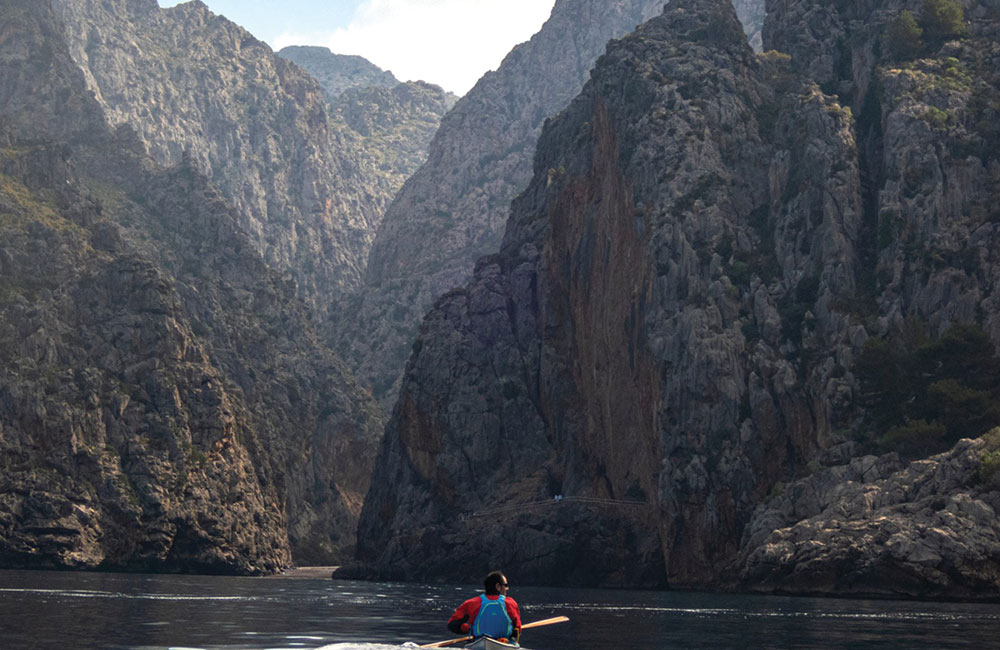
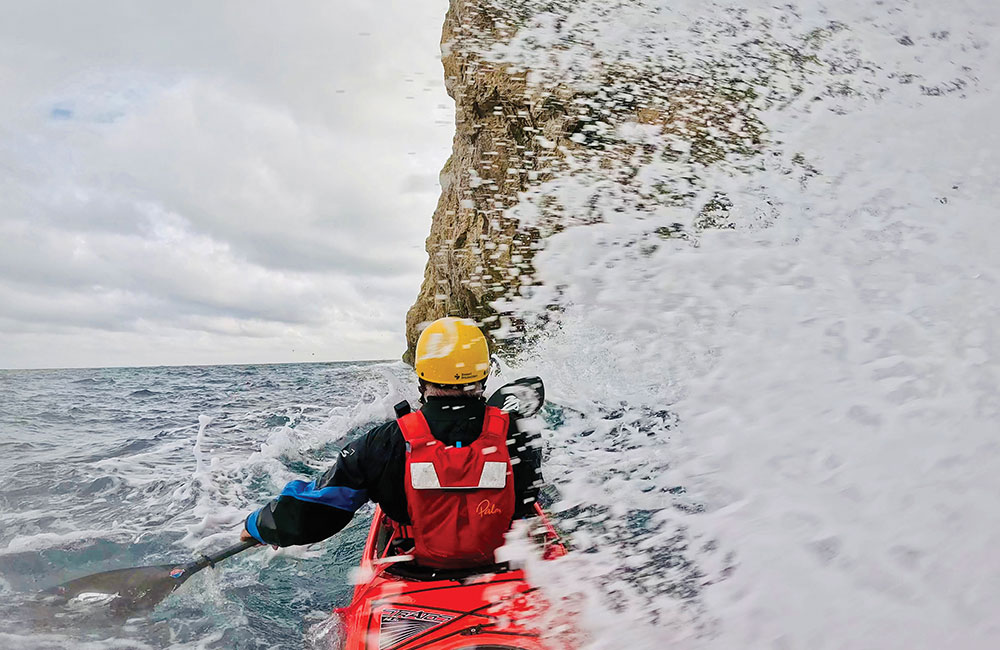
Mallorca is carbonate rock end to end, but its two great coasts are different stone. The northwest is hard, massive Lower Jurassic limestone, thrown up into the Serra de Tramuntana and plunging into cliffs of two and three hundred metres at Formentor. The south and southeast are younger and softer: Upper Miocene reef limestone, and marès, the golden calcarenite this island is built from. The north is a fortress wall; the south, a sculpture garden where every gap is a puzzle: passage, or trap.
Bare rock, sharp edges
The rock gardens of California and the Pacific Northwest are thick with life – kelp, mussels, barnacles; Welsh ledges the same, and Lofoten, where I spent a season guiding: granite furred with kelp to the tideline.
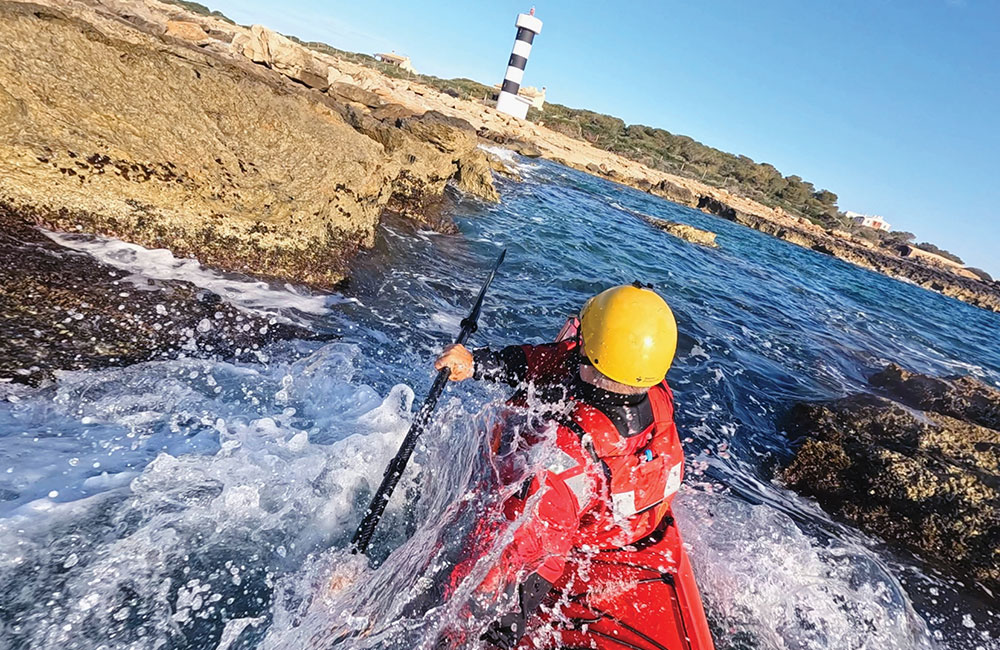
Ours are not. The warm, nutrient-poor, tideless Mediterranean grows little of that, so our limestone meets the water bare: clean, pale rock in sharp ridges and grooves. The upside is grip. The catch: a scrape the weed would have cushioned elsewhere opens a knuckle, or a gelcoat – which is why almost everyone here paddles plastic, and nobody brings a boat they love.
Where to point the bow
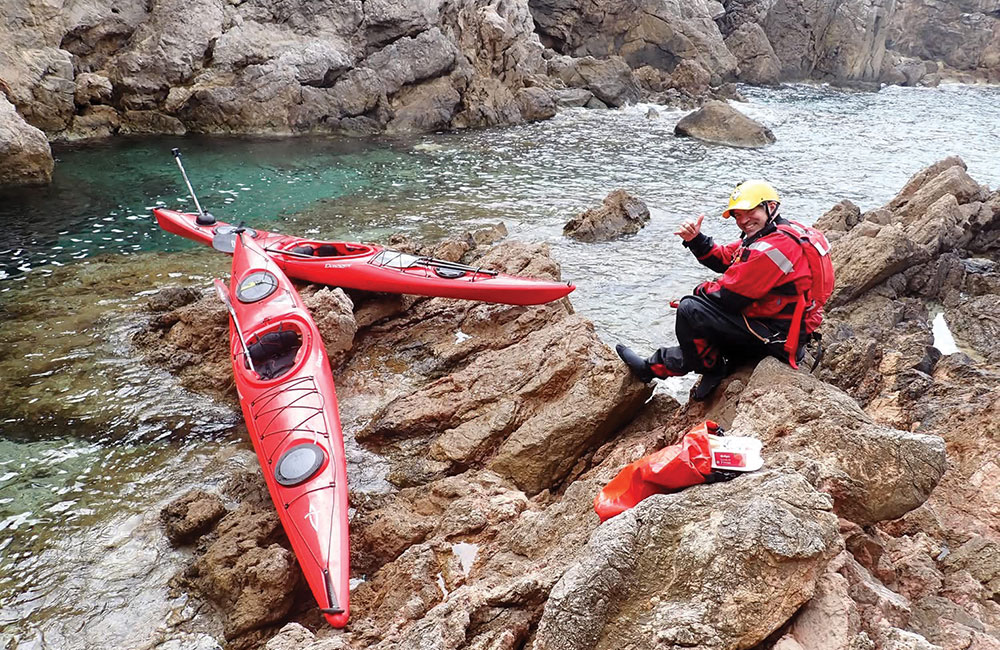
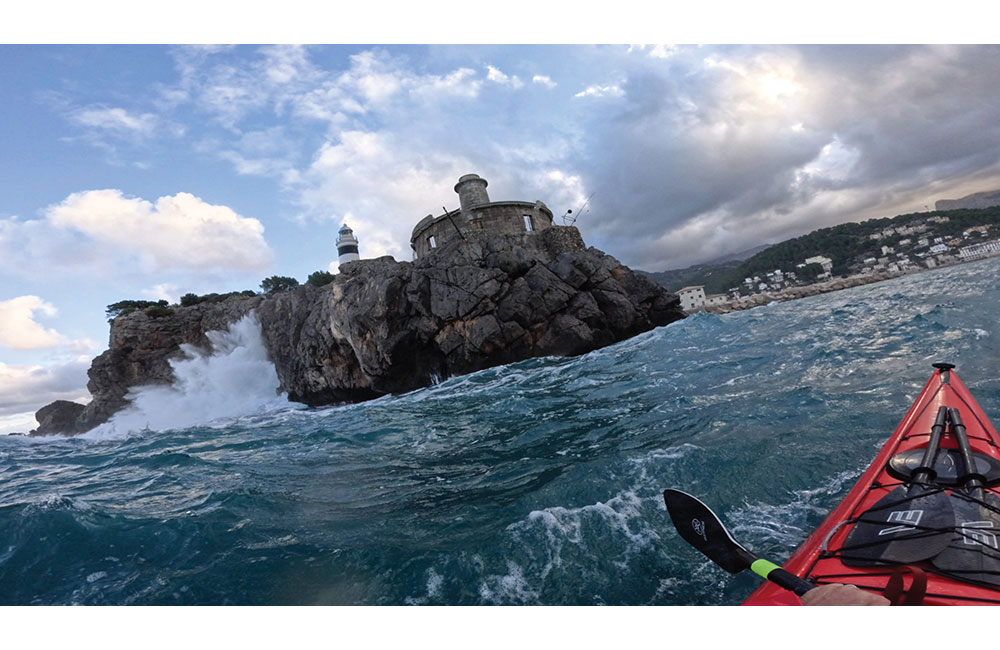
Each coast paddles differently: the south is where you learn, the northwest is where you commit. Santanyí, in the southeast, is the jewel – Miocene limestone carved into arches, slots and shelves. El Delta, in the bay of Palma, is where I send people first: its ledges come alive in half a metre of swell, and a few turn spicy past a metre. Sóller is big-wall rock-hopping; Cala Murada a warren of booming caves; exposed Capdepera, the island’s most technical clapotis. None has a fixed grade: the same gully is a gentle introduction on a calm day and a proper test when the swell is up.
Pour-overs, cascades, and a tideless garden
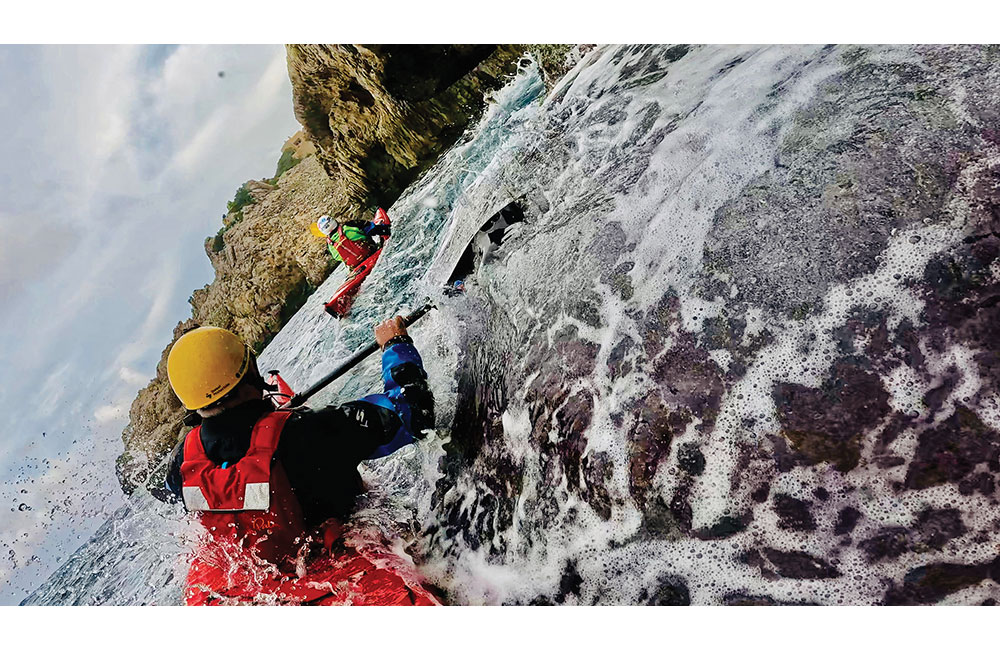
In river running, a pour-over is current spilling over a rocky ledge into a hole below. Eric Soares of the Tsunami Rangers borrowed it for the ocean: a flat rock or reef a wave surges over into calmer water on the shoreward side; a big one, ending in a temporary waterfall, they call a cascade. Our low limestone shelves make them everywhere.
The difference is that a river pour-over is predictable: the flow is constant, so what you scout is what you get. An ocean pour-over pulses; in the UK or the Pacific, that rhythm is the tide, filling and draining the feature. We do not have that. Astronomically, our tide barely exists: the spring range is under twenty-five centimetres. What moves our water is weather – pressure, wind, and the rissaga, a harbour seiche that can swing sea level metres in minutes. Nothing fills or drains the garden for you: the swell is the only engine. You read the forecast for period, direction and wind, not a tide table; wind rarely cancels a day here; it only decides which coast you drive to.
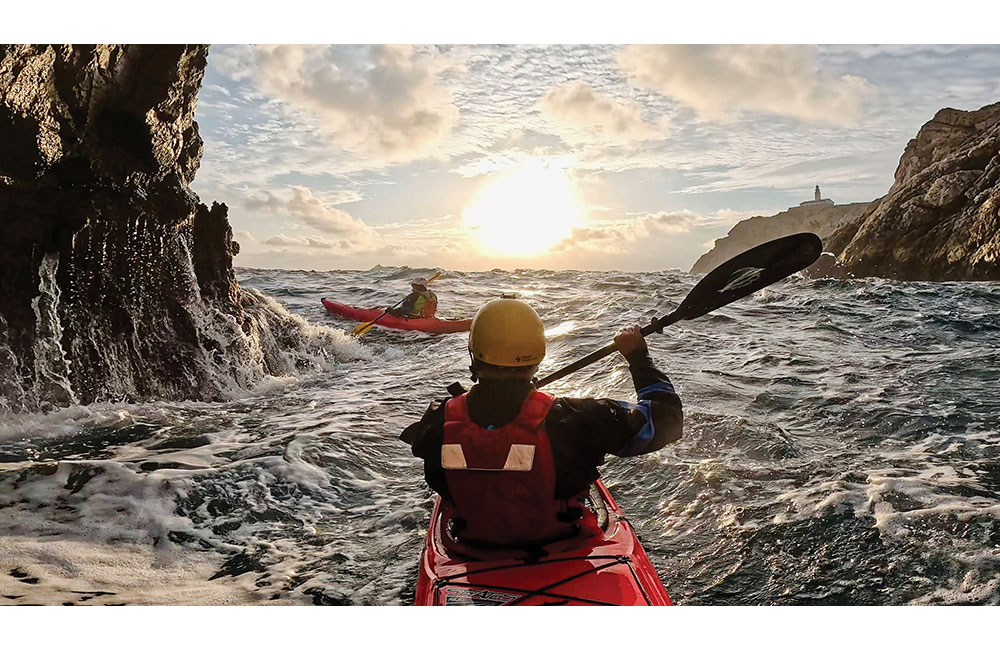
Get the timing right, and the surge carries you over. Simple to name, hard to do: sit outside, count the sets, pick your wave, let one go while you check the exit. Then a few strokes to match its speed, an edge off the rock, a stern rudder to hold the line, a low brace as it sets you down – and off the back before the next one arrives. Too early and you nose the seaward wall; too late and you are stranded on the ledge, at the mercy of the next wave. It is a game of half-seconds.
Get it wrong and what matters is composure. Tuck in tight, blade along the hull, less of you within reach of the rock. Every second under is another chance to meet rock with your head, or to be there still when the next wave lands. Panic is slower than calm. Roll on the side you are already on, or your strongest; in that water, left or right is a luxury. Trust the roll you have and do not rush it. And if you swim, get to the seaward side of the boat, never between boat and rock.
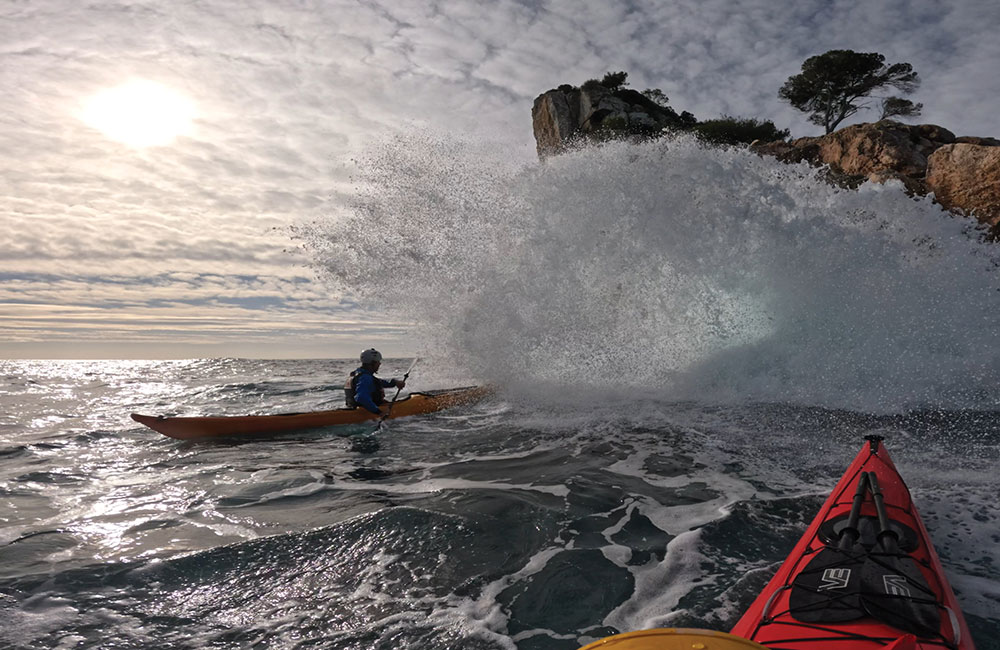
Our swell is not the Atlantic’s: no long-period groundswell, no raw power – and no rhythm. A groundswell lifts you like a lift; ours jolts- rebound-crossing swell, nothing long enough to settle into. What we get is short fetch – wind-built swell, waves stacked close together. That lowers the power but raises the demand: everything happens faster. It does not lower the consequence, and that is where visitors misread us.
Consequence here is measured in egress, not energy: much of the Tramuntana is cliff-bound, no landing for kilometres, no tide to refloat you. The sea hits softer here; getting out of it is harder. There is no pause on the far side: you clear the feature and keep paddling, or the sea decides for you.

The clarity that changes the game
One Mediterranean gift transforms this: water so clear it’s absurd. In murkier Atlantic gardens, part of the skill is guesswork – you commit half-blind. Here you see the submerged ledge, the reef beneath your hull, the shape of a gap before you enter. Clarity needs light, too, and with some 2,800 hours of sun a year, ours is nearly always lit; on a grey day even clear water goes opaque. It cuts both ways: that same water shows you exactly how shallow the pretty little slot really is. It keeps you honest.
Clapotis in a confined space
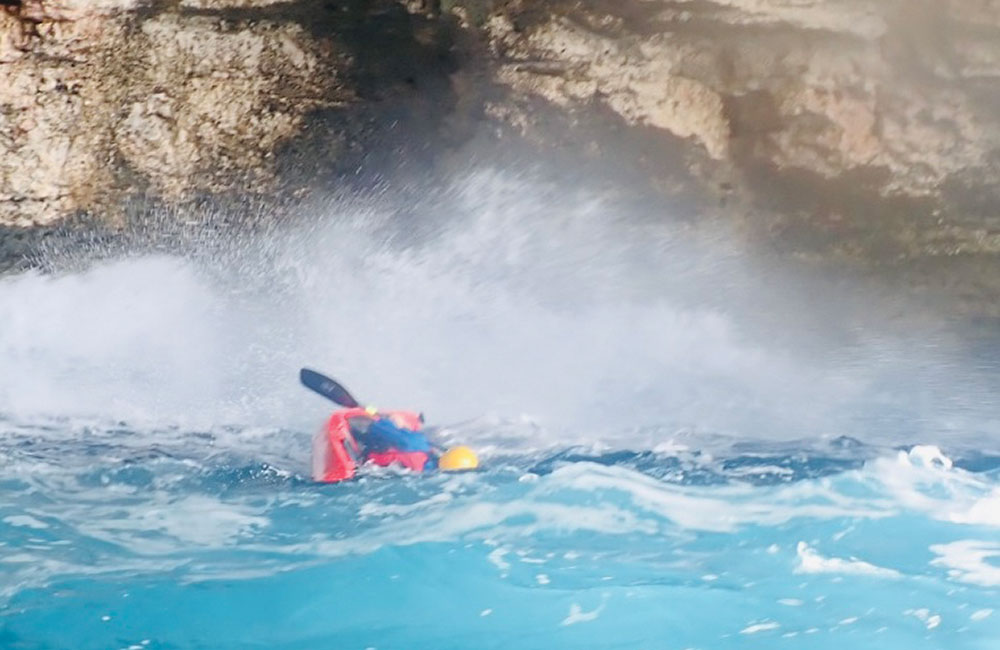
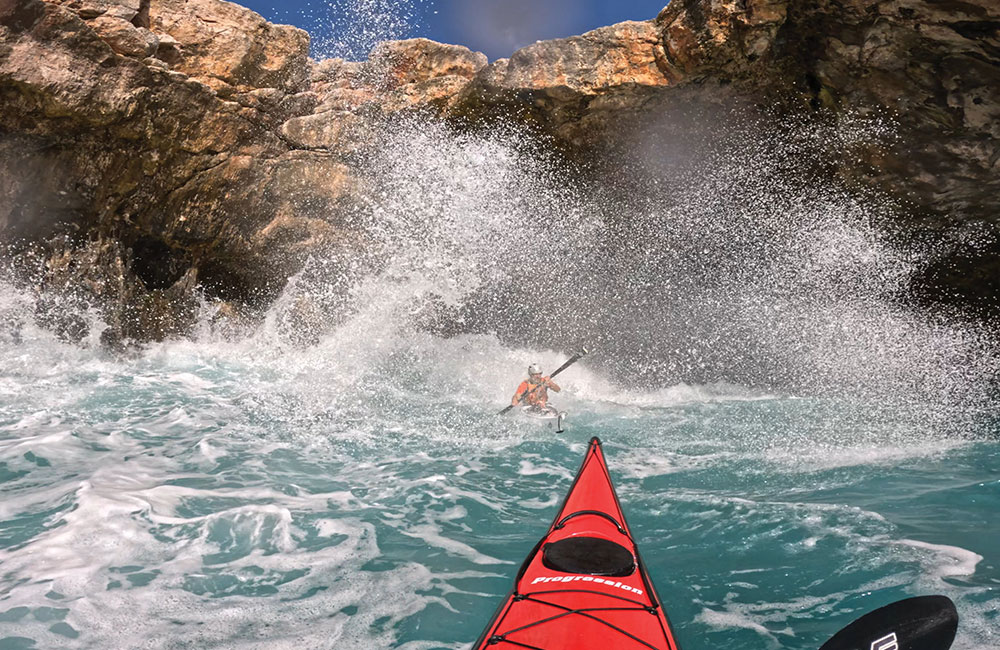
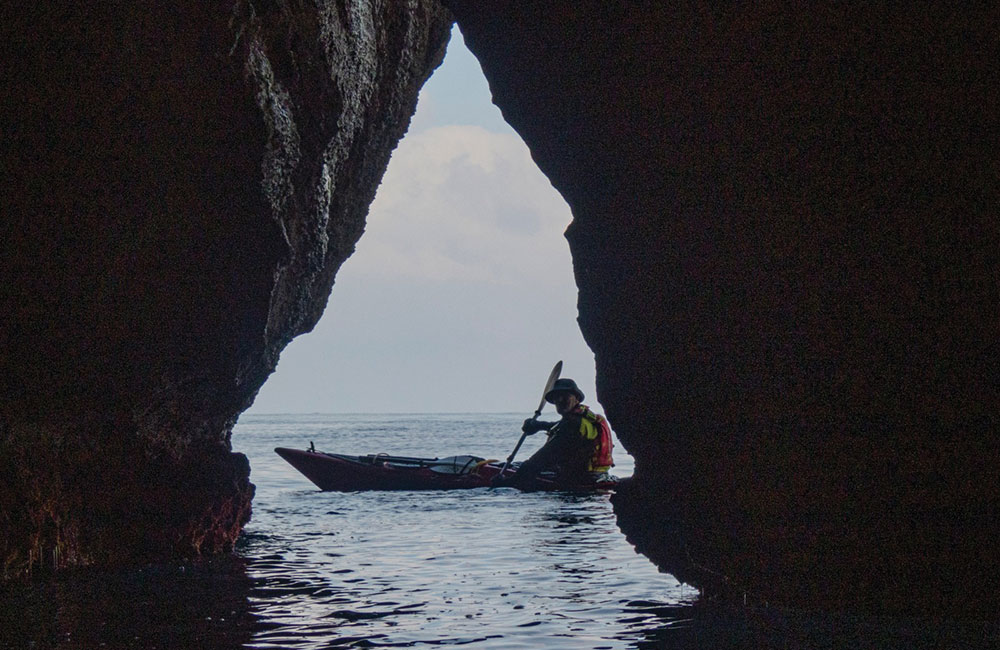
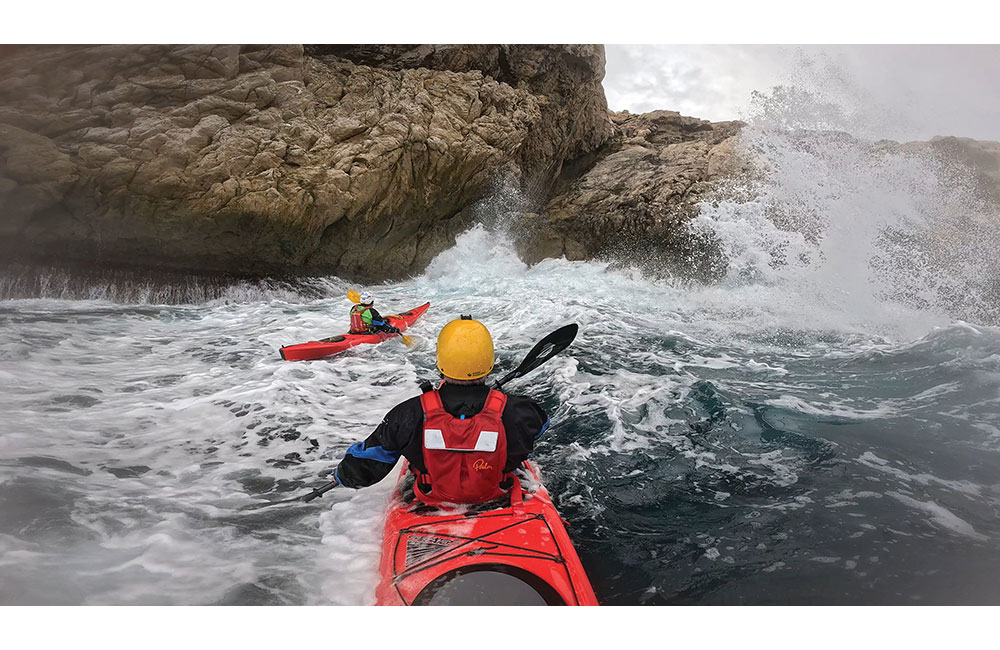
So much of our coast is vertical rock that the swell rebounds, and the multi-directional water it creates – clapotis – is a signature here. Squeeze into a slot or a cave mouth and one wall becomes several; the water stacking into short, steep peaks where rebounds cross – in a cave it detonates in spray. You ride not only the wave rolling in but its ghosts. A brilliant school: the boat is thrown around constantly, so every stroke has to count.
Warm water, cooler head
Rock gardening is as much about managing fear and adrenaline as about skill, and here Mallorca gives something the Atlantic cannot. In cold water, the cold shrinks your decisions before you capsize. Our sea bottoms out around 13-14 degrees in February. That does not soften the rock or the physics – it lowers the fear tax. Warm water buys you a longer swim; the group and the plan are what get you out. What it really buys is repetition: commit, fail, go again in the same session. Eric Soares said it plainly – practise in easy conditions until you are good enough to make it all the way – water to drill the skills for a colder trip north.
The discipline behind the play
None of this works without a team and a system. The best rock gardeners I have paddled with are not the most reckless but the most organised. British coaching drills it as CLAP – Communication, Line of sight, Avoidance, Position of maximum usefulness; the ACA teaches the same without the acronym, asking for honest self-evaluation before group evaluation.
Before anyone runs a feature, someone sits outside it, seeing the entrance and exit, and someone else holds the safe water. Communication is agreed before anyone commits – a whistle, a paddle signal, a clear go or no-go, because a shout is lost in the noise. Then one boat at a time: nobody enters a slot until the paddler ahead is out of it and clear. It will not make a swim beside the rocks routine – nothing does, but it gives a plan instead of an improvisation.
So the old rules stand. A helmet. A buoyancy aid you can swim in – a partner. A tow, a knife and a way to call for help on your person, not in the day hatch – which is on the boat, and the boat may not be with you. Scout the feature, then rehearse it in your head. And master the art of the no – knowing where enough is, and walking away without regret. But be brave, too: “Ningún mar en calma hizo experto a un marinero” – “No calm sea ever made a skilled sailor.”
Whose coast it is
One more rule, and it is not about you: these cliffs and caves are somebody’s nest. The Balearic shearwater – Europe’s most threatened seabird, and only ours – lays in sea caves from late February until the chicks leave in July; the Mediterranean shag nests low in the same caves in December and January, exactly when the gardens are at their best.
Ospreys and Eleonora’s falcons hold the ledges above, and desert a nest over a distant boat. Only Cabrera binds you legally – a permit to navigate, landing at the quays alone. Everywhere else the rules cover fishing, diving and anchoring, not paddling: the birds are protected by your judgement, not a line on a chart. The gardens are not going anywhere; the shearwaters might.
An open invitation
We have proper rock gardening here – clear water over intricate limestone, pour-overs and cascades – and almost nobody in it. The cyclists found their climbs, the climbers their walls; the gardens sit quiet and waiting. That still strikes me as a small tragedy. So far the visitors are two: one from Wales, who came twice, and one who learned in the same corner of California where the Rangers started. That is not a crowd; it is a verdict.
So consider this article an invitation, in the same generous spirit the crews I admire have always shown. The water is warm, the rock is beautiful, and the boat is waiting to dance. Come and play La Roqueta – bring your helmet, come when the cliffs are quiet, and let the sea show you the way in.
PLANNING A TRIP
Swell season runs roughly October to June, and the cleanest windows come between fronts. July and August are flat and hot – fine for rolling practice or an early tour before the heat, but not for long days and not for conditions. Wind hardly ever costs you a day on an island: the tramuntana shuts down the northwest while llebeig and migjorn light up the south, so you drive to the other coast – or take the downwind it is offering you. Bring a short plastic boat and a helmet. Visiting paddlers are welcome to get in touch.
@unai.seakayak
Facebook: Unai Aldana