Words & photos: 
Marc Ornstein
Marc Ornstein
The physics of FreeStyle (without the numbers)
FreeStyle canoeing has been described as “The art and science of quiet water paddling.” In this article, I’ll discuss the science components. Although these concepts apply to all canoeing disciplines, freestyle is the only discipline where the entire curriculum is structured around them. Several of our instructional events begin with an evening ‘chalk talk’ where these principles are explained and demonstrated before students ever put their boats in the water.
Canoes respond, in a predictable manner, to whatever forces are being exerted upon them. Those forces are:
- Paddle movements.
- Forces created by the shape of the hull, as it travels through the water.
- Water currents.
- Wind.
This discussion will deal with items 1 and 2. Items 3 and 4 are topics for another day.
Let’s begin with paddle movements
Newton’s third law of motion states that for every action, there is an equal and opposite reaction. This is the basis for most of what happens when one paddles a canoe.
Picture a longitudinal slot through the canoe’s centerline, forward of the paddling station. (For those familiar with small sailboats, picture a centreboard slot.) Now picture the paddle inserted through this slot; the blade submerged with its faces perpendicular to the keel line and the paddle shaft vertical.
If you pull the paddle straight back, the canoe would respond by moving straight forward (assuming the hull is not heeled and barring any action by wind or waves). The canoe would not deflect (yaw) left or right. The direct, rearward force of the blade against the water would result in a direct forward motion of the hull.
Of course, in the real world, we don’t have such a slot in the hull. The paddle blade is offset to one side of the hull or the other. This offset propels the paddle side with more force than the offside, resulting in yaw (the hull turning away from the paddle side). This yaw will need to be corrected, generally by using a J correction or pry. The farther away from the centerline the blade is placed, the greater the yaw and, consequently, the greater the correction required. Corrections, even small ones, slow the boat, steal momentum, and reduce efficiency.
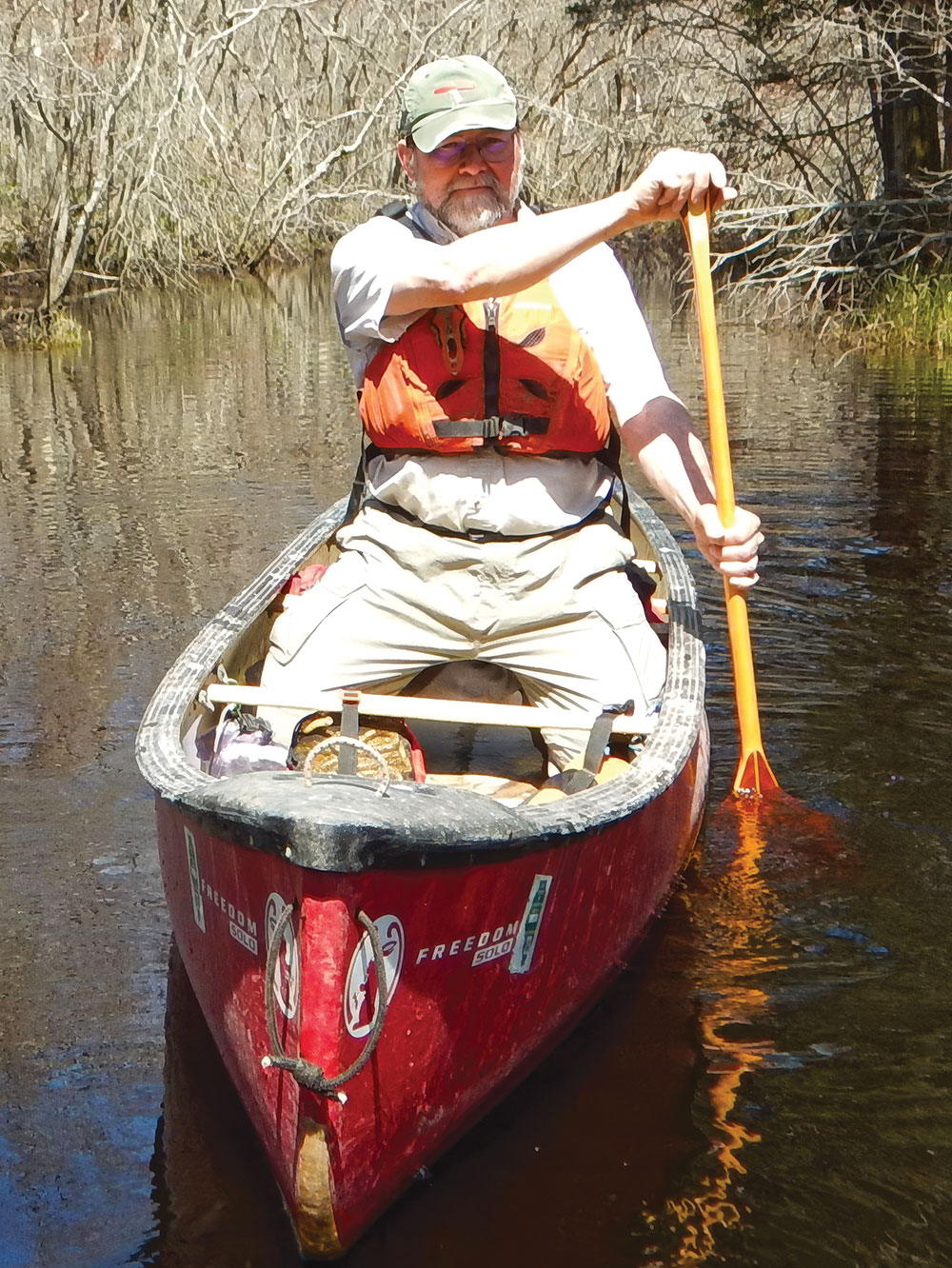
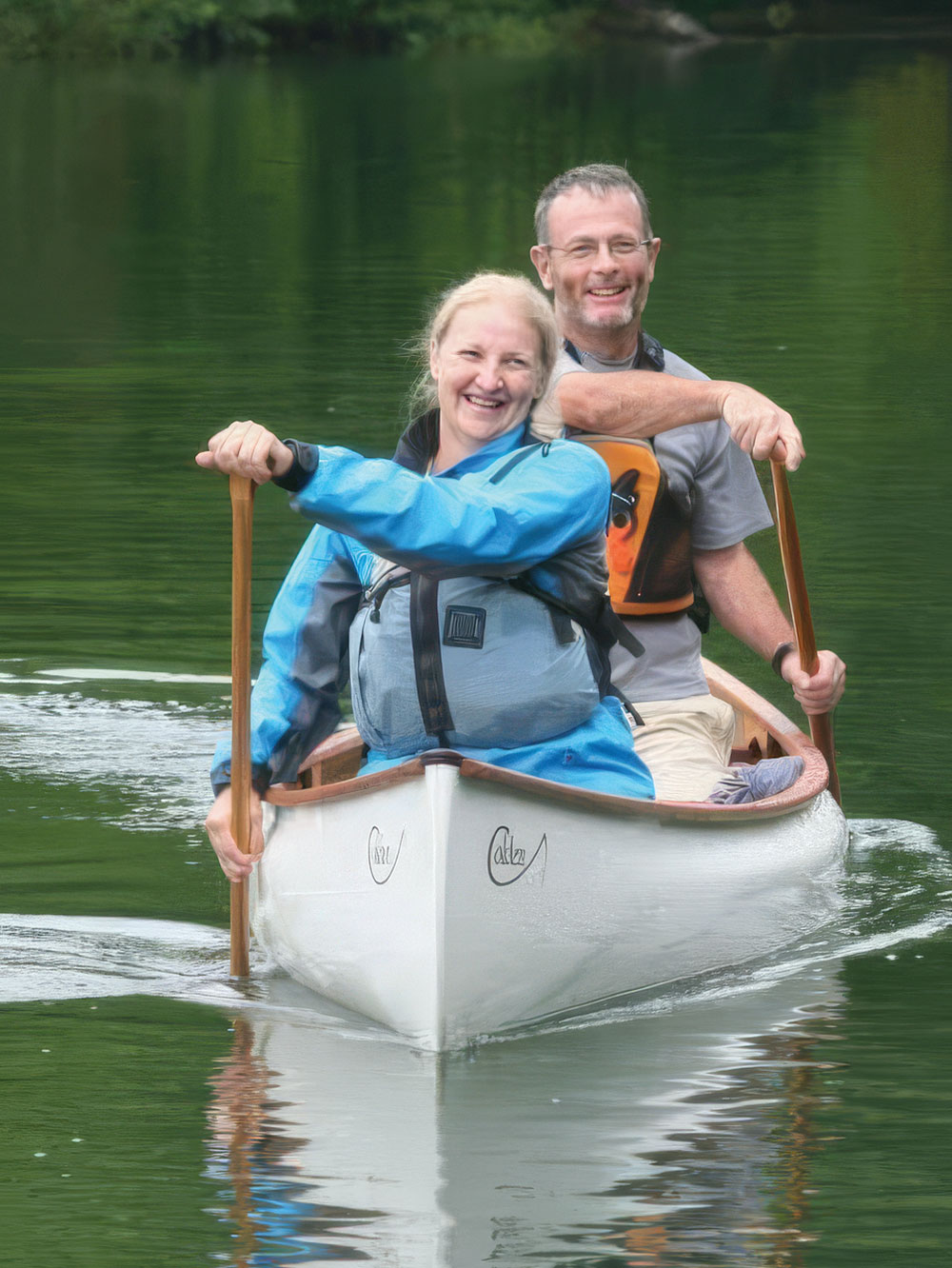
An efficient paddler keeps the paddle blade close to the boat by extending the shaft hand outward, over the gunwale, and keeping the grip hand (with the arm fully extended) out over the gunwale and ‘stacked’ as directly over the shaft hand as possible. Holding the paddle this way ensures the paddle shaft is nearly vertical. The paddle is drawn straight back (not following the curvature of the hull).
The stroke is also quite short (more on this in a bit), beginning as forward as one can comfortably reach without undo bending at the waist. The power portion of the stroke ends when the blade reaches the paddler’s knee. The entire power portion of the forward stroke is typically less than 18 inches. Such a stroke yields minimum yaw and thus requires minimum correction.
- Canoes steer primarily from the stern. By keeping the power portion of the forward stroke as far forward as possible, turning forces stay farther from the stern and create less yaw.
- Throughout the power phase of the forward stroke, the paddle must remain nearly vertical, not only laterally but also longitudinally. Reaching too far forward at the catch or entry portion of the stroke causes the blade to enter the water at an oblique angle and press down on the water rather than pull back against it.
- The correction (J) portion of the stroke takes place near the stern. Once the power portion of the stroke has ended (near the paddler’s knee), the paddle is allowed to ‘drift’ back as far as the paddler can comfortably reach. A correction near the stern is most efficient because, as noted above, that is where most of the steering takes place.
Understanding the physics of, and mastering, the forward stroke is arguably the single most important canoeing skill to master.
Forces created by the shape of the hull, as it travels through the water:
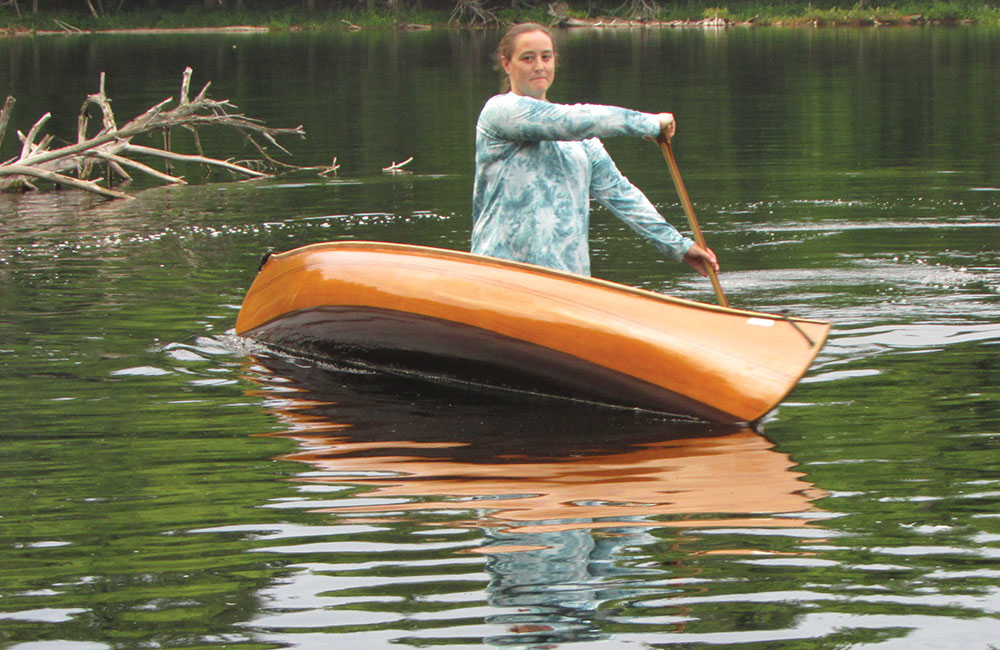
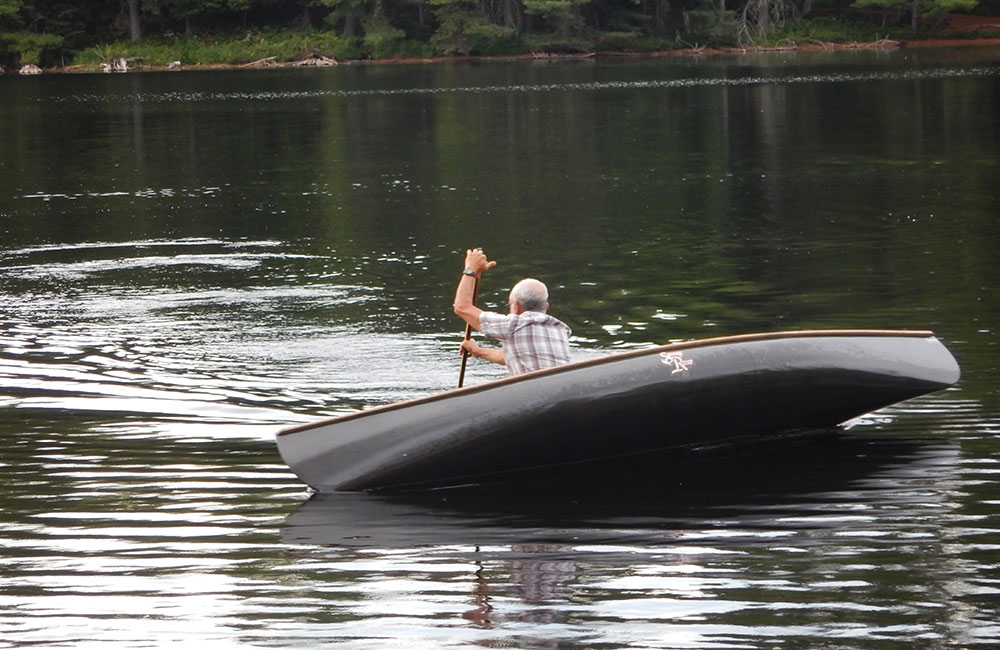
Canoe hulls are symmetrical, laterally (from side to side). Even so, called asymmetrical canoes are only asymmetrical longitudinally. This lateral symmetry remains as long as the hull sits level, side to side, in the water. When the hull is heeled, that symmetry is lost.
- Heeling the hull, either toward or away from the paddle side, shortens the waterline. As the canoe is heeled, the side of the hull effectively becomes the bottom of the hull. Since the sides of the canoe are curved (the centre being wider than the stems), heeling creates more rocker, resulting in a shorter waterline. Canoes with shorter waterlines turn more easily.
- This phenomenon allows us to modify the effective shape of the hull at any time. A typical touring canoe, with minimal rocker, will easily track and hold a straight course when paddled level. That same canoe may instantly be converted into a significantly rockered hull that will turn on a dime, simply by heeling it.
- Heeling the hull also causes a degree of lateral imbalance; without getting lost in the physics of why, suffice it to say that a heeled hull will always tend to turn away from the direction of the heel. Barring outside forces, such as wind, waves or paddle manipulations, a hull that is heeled left will tend to turn right, and a hull that is heeled right will turn left. This is known as carving. We can use the carving effect to our advantage in several ways. (Note: It is physically easier to heel toward the paddle side than away from it, but with practice, you can do both.)
- We can use it to increase the efficiency and effectiveness of a turn by heeling in the opposite direction (heel left when turning right/heel right when turning left).
- We can use it to correct for yaw by heeling away from the paddle side. With a highly refined forward stroke, simply heeling away from the paddle side may eliminate the need for J corrections or minimise the amount of correction required.
- We can use it to counter the effect of weather cocking. If the wind is causing the canoe to weather cock, heeling the canoe can often be an effective way to counter it.
- Introducing pitch is another way to alter the effective shape of the hull. Pitching the leading stem (generally the bow) downward causes the trailing stem (generally the stern) to rise. Since the canoe turns primarily from the stern, it is now free to turn more easily. If one is paddling in a kneeling stance, pitch is easily accomplished by lifting one’s butt off the seat and transferring most of one’s weight onto the knees.
- Lastly, heel and pitch may be applied individually or combined, allowing the paddler to continuously adjust the hull shape to the conditions at hand and the desired effect.
Understanding the various forces affecting your canoe is a vital step toward mastering control. Practice these techniques until they become second nature, and your paddling will become more efficient, effective and most importantly, more fun.
A couple more articles about the physics:
https://freestylecanoeing.com/lets-get-things-straight/, and https://freestylecanoeing.com/a-pitch-for-heeling-part-1/ and https://freestylecanoeing.com /a-pitch-for-heeling-part-2/.